Scientists explained why Antarctica unexpectedly gained ice
Despite global warming, Antarctica's ice sheet suddenly gained mass in 2021–2023, reversing its usual loss trend.
An international team of scientists, who published a study in Nature, found the cause not in Antarctica itself, but thousands of kilometers away — in tropical waters near the Malay Archipelago.
The gist
- In 2021–2023, the Antarctic ice sheet unexpectedly gained mass instead of the usual loss: over 22 months, the increase amounted to 695 gigatons — a record figure in 20 years of GRACE satellite observations.
- Scientists linked this to the multi-year warming of the so-called "tropical warm pool" — the waters near the Malay Archipelago, where the Pacific and Indian Oceans converge.
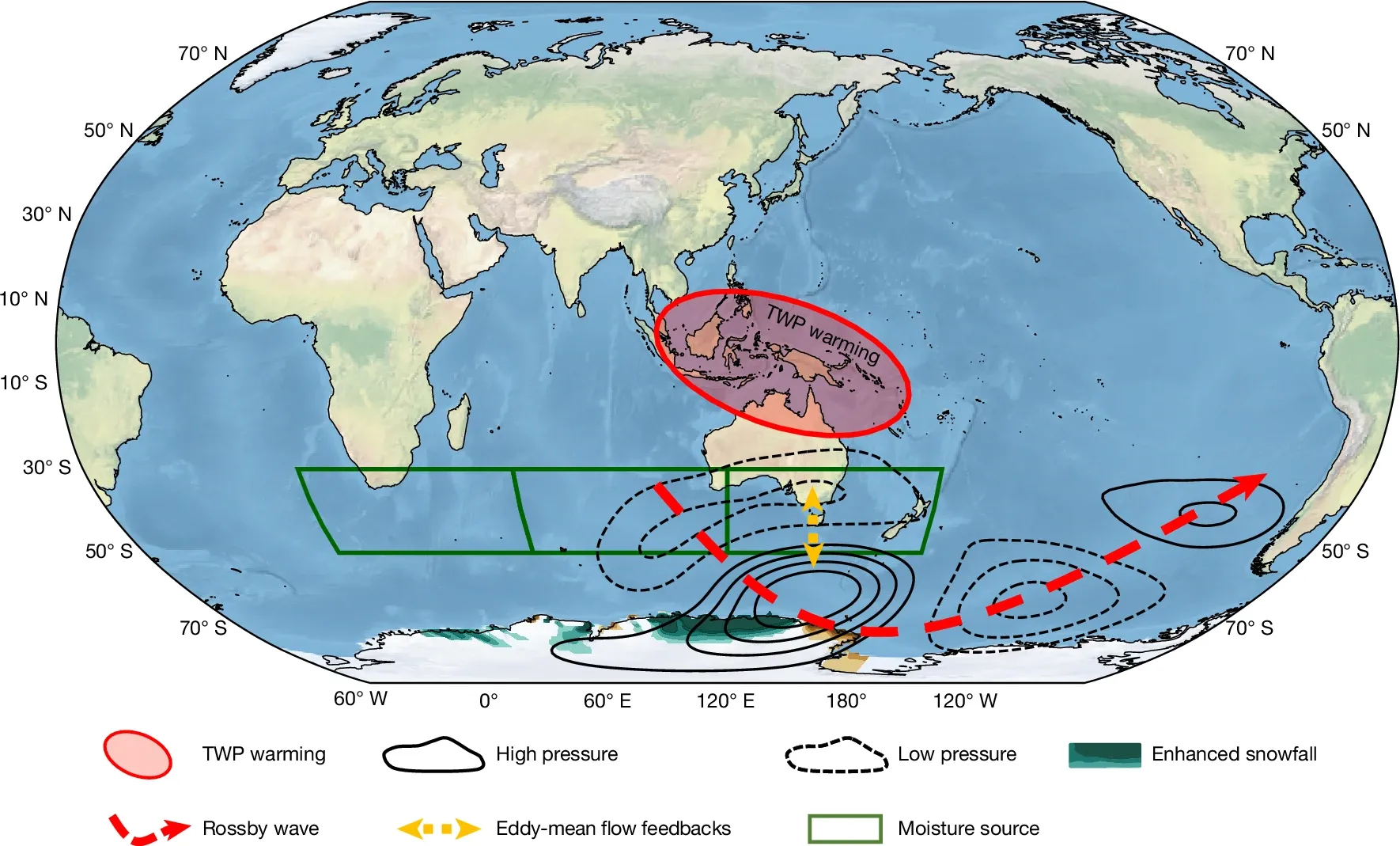
- The warming excited Rossby waves — atmospheric disturbances that reached East Antarctica and caused heavy snowfall over Queen Mary Land and Wilkes Land by transporting moisture from the Indian Ocean.
- The anthropogenic factor of global warming explains only about 9% of the recorded snow increase; scientists emphasize that the phenomenon is temporary and recurs roughly once a decade, and does not reverse the long-term trend of ice sheet melting.
How the tropical ocean controls Antarctica
The mechanism described by the study's authors shows how closely connected the distant parts of the planet's climate system are. Sustained warming of the ocean surface in the tropical warm pool region creates a zone of high atmospheric pressure, from which a chain of Rossby waves begins to propagate — large-scale meanders of high-altitude winds moving southward. Upon reaching Antarctica, these waves form two pressure centers of opposite sign — a cyclonic one south of Australia and an anticyclonic one directly off the coast of East Antarctica. Together, they intensify the transport of moist air from the Indian Ocean precisely into the sector of Queen Mary Land and Wilkes Land, where record snowfall occurred, providing almost 70% of the entire continental ice mass gain.
Why this does not negate global warming
The study's authors specifically emphasize: the observed gain is not a sign that Antarctic melting has stopped. Model calculations showed that the share of anthropogenic warming in the recorded snow increase was only about 9% — meaning the tropical mechanism played the primary role, not the global climate trend. West Antarctica continues to lose mass at a steady rate, and some outlet glaciers of East Antarctica, including Totten Glacier, remain vulnerable to warm ocean waters undercutting them from below. Similar episodes of multi-year tropical warm pool warming, according to the scientists' calculations based on both observations and climate models, occur roughly once a decade — meaning the current gain will most likely prove to be a temporary pause rather than a reversal of the trend.
Connection to phenomena we have already covered
The mechanism described in the study is another example of how temperature anomalies in tropical waters can determine weather and climate thousands of kilometers from where they originate. We have repeatedly written about similar logic in relation to the emerging super El Niño — a sea surface temperature anomaly in the Pacific Ocean whose influence is felt from African farms to Kazakhstan's summer heat. The Antarctic study shows that such tropical teleconnections operate not only in the familiar El Niño context, but also through lesser-known mechanisms such as tropical warm pool warming, meaning our understanding of the planetary climate system continues to be refined even regarding regions that would seem to be already well studied by satellite observations.
Author's conclusion
The Antarctic ice story is a good lesson against hasty conclusions in either direction: a temporary mass gain does not disprove the melting trend, just as one cold day does not disprove global warming. The value of such research lies elsewhere — it shows that even a seemingly local system like the East Antarctic ice sheet is governed by processes unfolding in tropical waters many thousands of kilometers away, meaning accurate projections of global sea level rise require accounting for a far more complex network of climate connections than previously thought.


Comments ()