Singapore launches world's first data center using living human neurons
Singapore unveils the world's first biological data center prototype: 16 million living human neurons grown from stem cells replace silicon chips.
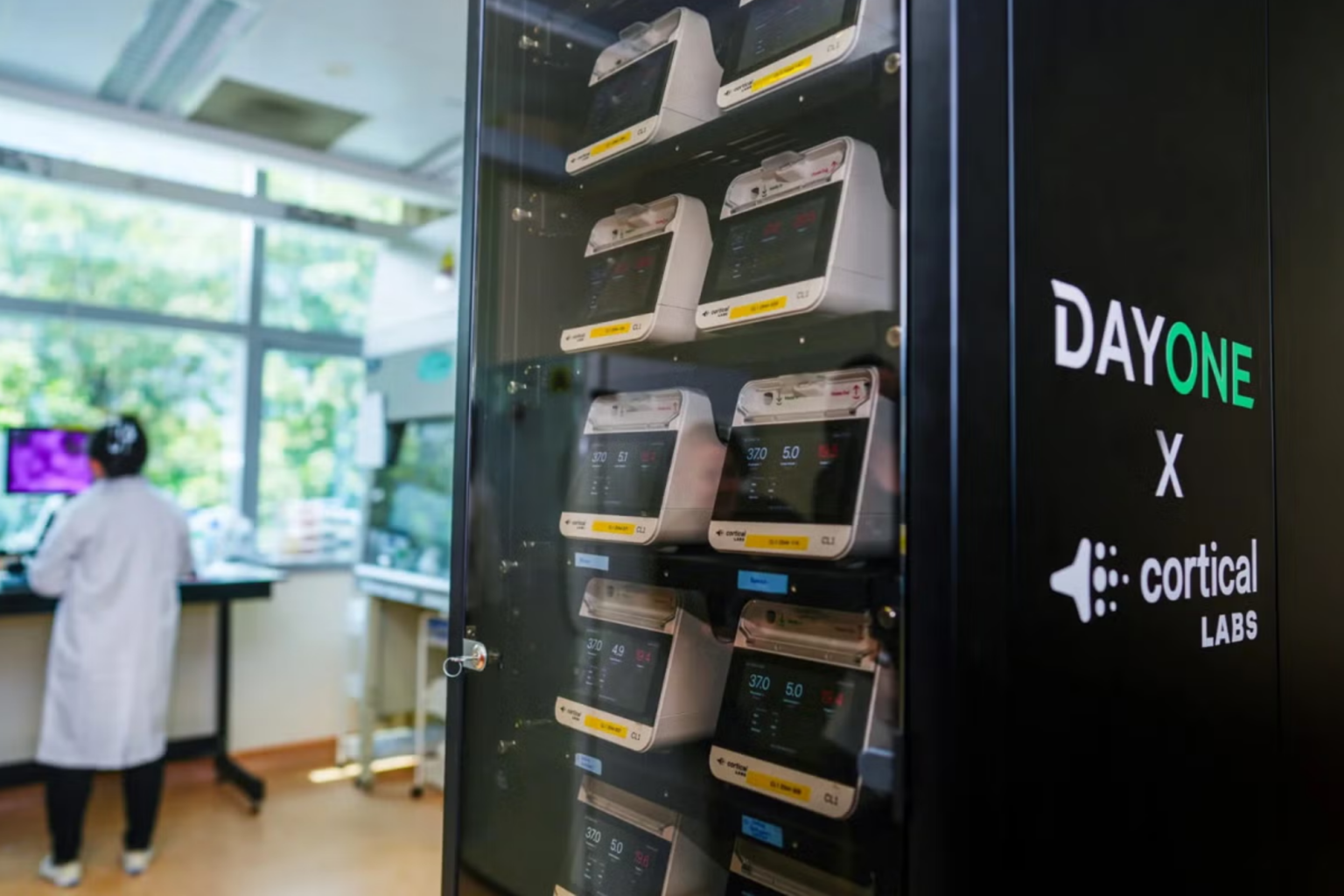
The project was implemented by the Yong Loo Lin School of Medicine at the National University of Singapore together with data center developer DayOne and startup Cortical Labs. The system processes data in a fundamentally different way than classical servers — and could potentially do so using only a fraction of their energy consumption. For Kazakhstan, which is actively attracting investment in digital infrastructure and suffering from water stress, the emergence of energy-efficient alternatives to traditional data centers is a signal worth monitoring.
The gist in brief
- The biological data center is located at the NUS Institute of Life Sciences and consists of 20 CL1 modules — the world's first commercial biological computers that can be loaded with code. Each module runs on 800,000 lab-grown human brain cells. That makes 16 million neurons in total.
- The neurons are connected to computing hardware via microelectrode arrays — they enable the transmission of electrical signals between biological cells and digital systems.
- Key advantage: living neural systems are capable of learning from limited amounts of data and adapting to changing conditions — unlike AI models that require massive datasets.
- Potential application areas include drug development, humanoid robotics, cybersecurity, fraud detection, and the study of neurological diseases.
- Neurons live for about 6 months — this is the main technical limitation. NUS Medicine takes on the cultivation and maintenance of the cells.
How it works: neurons instead of transistors
A traditional data center is billions of transistors switching between "0" and "1" states. The biological computing module CL1 works fundamentally differently: living neurons grown from stem cells form neural networks that process information through electrical impulses — just as happens in the human brain.
"By growing living human neurons from stem cells and combining this with rigorous engineering, we are not just creating a more efficient alternative to silicon; we are creating a platform that can help us understand the processes of learning and adaptation directly at their biological source," explained NUS Medicine professor of neuroscience Ricky Patani.
Why this matters right now
Electricity consumption by data centers is growing at an alarming rate: according to the IEA, it grew by 17% in 2025. We have already written about how New York imposed a moratorium on the construction of large data centers precisely because of colossal energy consumption and the strain on water resources. The AI boom is making the situation even more acute.
Biological computing offers a fundamentally different path: according to the developers, biological computing can be performed using only a fraction of the energy required by conventional digital computers. The human brain is one of the most energy-efficient computing devices in nature, consuming about 20 watts while delivering enormous computational power.
Limitations: neurons live for six months
The main technical limitation of the system is the lifespan of the neurons. According to sources, the neurons "expire" after roughly six months. This means regular replacement of biological components — a task fundamentally different from maintaining silicon hardware.
That is why NUS Medicine takes on the ongoing cultivation of new cells and the maintenance of their vital functions. Scaling this process is one of the key challenges on the road from prototype to commercial product.
Kazakhstani context
Kazakhstan is consistently developing its digital infrastructure and attracting investment in data centers as a regional IT hub. At the same time, the country suffers from chronic water stress — and traditional data centers consume enormous amounts of water for cooling.
Biological computing remains a prototype-level field for now — commercial scaling is years, if not a decade, away. However, the very fact that a fundamentally different computing paradigm has emerged — one that is less energy-intensive and potentially less water-intensive — matters for long-horizon digital infrastructure planning. Kazakh regulators and IT-sector investors should keep an eye on this direction: technologies that change the rules of the game rarely announce their arrival in advance.
Author's conclusion
A data center made of living neurons is not science fiction and not a metaphor. It is a working prototype presented to the public on August 6, 2026, in Singapore. For now, it processes data more modestly than silicon supercomputers — but it learns faster and consumes less. If biological computing ever reaches industrial scale, it will change the very logic of energy consumption in the digital economy — in which Kazakhstan aspires to hold a prominent place.



Comments ()