Spanish scientists have created plants that glow and change color when infected with viruses.
Signal plants: new tech detects viruses and pests early. Glow from infected plants is captured by a standard camera.
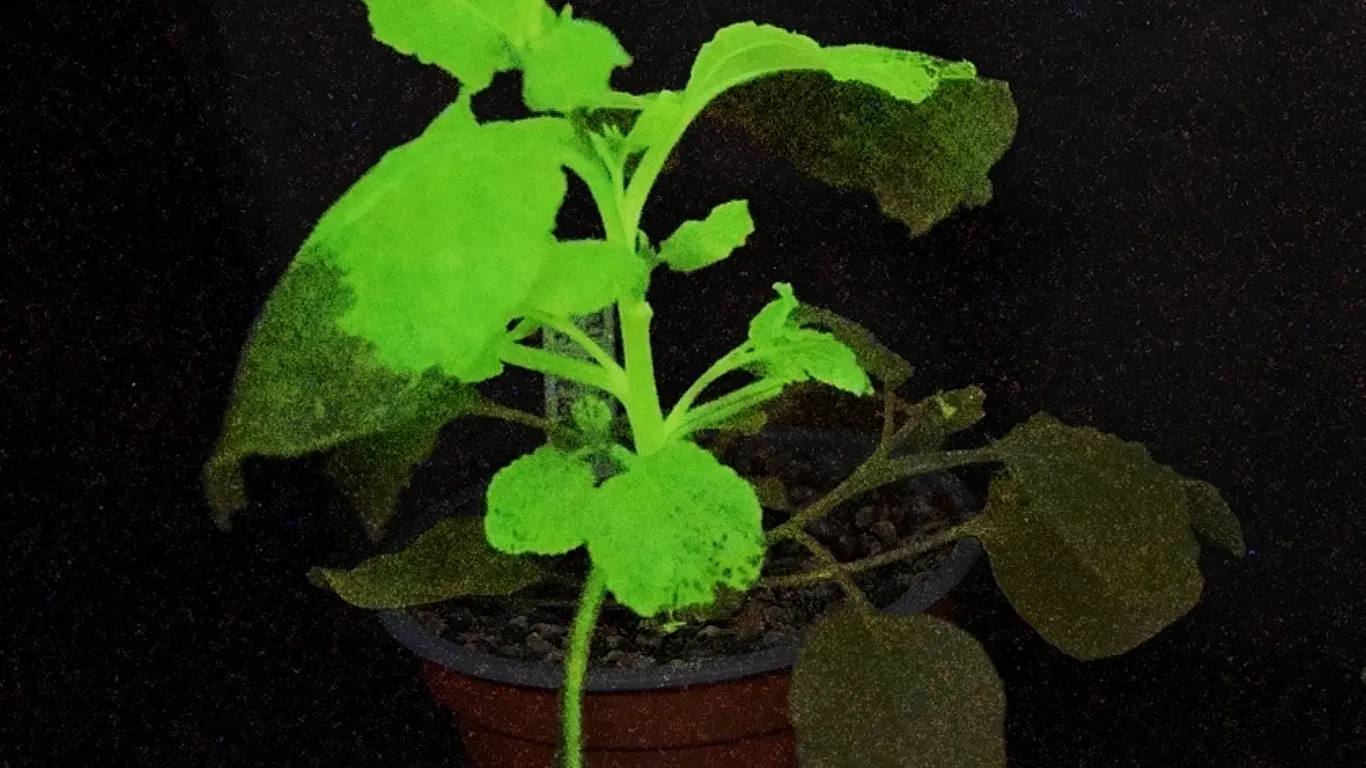
Researchers at the Institute of Molecular and Cellular Biology of Plants (IBMCP) at the Polytechnic University of Valencia have created a biological system for early detection of crop diseases. Plants glow in the dark and change color when infected by viruses — even before visible symptoms appear, and this can be recorded using ordinary cameras, reports Euronews. For Kazakhstan, where annual crop losses from diseases and pests amount to billions of tenge, this technology is not distant science, but a potential tool for protecting the agricultural sector.
The Gist Briefly
- Spanish scientists have developed a system where plants constantly emit green light, and when infected by a virus, they change the color of the signal — this is detected by an ordinary camera without laboratory equipment.
- The technology is based on four enzymes that modify a natural plant compound (caffeic acid) so that upon oxidation, a light-emitting molecule is formed. The inspiration came from fungal bioluminescence.
- The system has been tested on Nicotiana benthamiana plants — a relative of tobacco and a standard model for agricultural research. The results were published in the journal Nature Communications.
- In the first phase, the technology is planned for use in greenhouses — "sentinel" plants will signal the first outbreaks of infection. In the future, the system will be adapted to detect bacteria and fungi.
Why Current Diagnostics Don't Satisfy Farmers
Traditional methods for diagnosing plant diseases — PCR or ELISA — provide high accuracy in detecting viral genetic material or proteins. However, their application requires time, specialized equipment, and qualified laboratory personnel.
By the time a farmer collects samples, sends them to a lab, and waits for results, the disease has already spread to neighboring crops. The Spanish development breaks this logic: the plant itself signals an infection in real time, without the need for a laboratory.
How the System Works
Inspired by fungal bioluminescence, the research team developed a system that allows plants to emit different light signals depending on their condition.
The system uses four enzymes that modify a natural plant compound — caffeic acid — so that upon oxidation, a molecule capable of emitting green light is constantly produced. This is the background signal of a healthy plant.
When a virus appears, the picture changes: a pathogen enzyme triggers a color change, detectable with inexpensive devices, facilitating early detection. No reagents, no laboratory — just a camera and the changed light.
From Greenhouses to Fields
In the first phase, the system can be used for early monitoring of viral diseases in greenhouses and other controlled crops, utilizing "sentinel" plants capable of warning about the first outbreaks of infection.
In the future, the technology can be adapted for other pathogens — bacteria and fungi — and could become a key tool in the face of the spread of new agricultural threats related to climate change.
Kazakhstan Context
For Kazakhstan's agricultural sector, the technology is particularly relevant for several reasons. First, the country has a large greenhouse sector that has been actively developing in recent years — precisely where such monitoring systems are most applicable in the first phase. Second, outbreaks of diseases in grain, vegetable, and melon crops are recorded annually in several regions, and diagnostics are often delayed due to the remoteness of farms from laboratories.
The technology is at the stage of laboratory testing — years will pass before commercial application. However, the Ministry of Agriculture and domestic agricultural universities should already be tracking its progress: it is precisely such developments that will shape the face of precision farming in the next decade.
Author's Conclusion
A plant that reports its own illness is not science fiction, but a result published in Nature Communications. Spanish scientists have taken a step from reacting to disease to preventing it — and they did so using tools available to any farmer with a camera in their pocket. For an agricultural sector accustomed to learning about infection from yellowing leaves, this is a paradigm shift.


Comments ()