Students from the Netherlands create world's first solar-powered ambulance
A Dutch student team unveiled an off-grid medical vehicle that reaches remote areas without relying on power grids or regular fuel supplies.
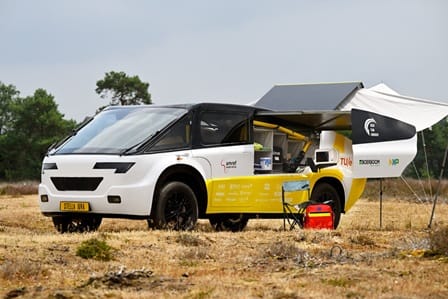
The project is called Stella Juva — the world's first ambulance with a solar power system. It was created by 23 students from the Eindhoven University of Technology, many of whom put their studies on hold for this project, writes Sovmash.com. For Kazakhstan, with its vast distances between villages and high levels of solar insolation, the idea deserves serious interest.
The Gist
- Stella Juva is the world's first ambulance with a solar power system. On a sunny day, the vehicle can travel up to 715 kilometers without recharging. The maximum speed is 120 km/h. The design is built for off-road driving.
- The main idea of the project is not to transport patients to hospitals, but to bring medical care to people. The vehicle can function as a small mobile doctor's office right in a remote village.
- Inside, it is equipped with a defibrillator, a portable X-ray machine, an ultrasound diagnostic device for examining pregnant women, a refrigerated compartment for storing vaccines, and kits for diagnosing tuberculosis.
- The battery charges both from solar panels and while driving. This allows the equipment to continue operating at night and in cloudy weather.
- In the near future, the team plans to send Stella Juva to Kenya for real-world testing. The project's partner is the humanitarian organization Amref Health Africa.
Medicine Goes to the People — Not People to Medicine
Project leader Matthijs van Gerwen said the vehicle was created specifically for regions where medical infrastructure is poorly developed and distances between settlements are very large.
The logic is reversed compared to traditional medicine: usually, the patient is taken to the equipment. Stella Juva takes the equipment to the patient — and does so autonomously, without relying on fuel infrastructure or power grids. As long as the sun is shining, the vehicle can charge right on the spot — and work there for hours without needing to return to base.
According to representatives of Amref Health Africa, in many African countries, residents of remote villages are tens or even hundreds of kilometers away from the nearest medical facility. Public transport is poorly developed, fuel is expensive, and electricity supply is often unreliable.
Solar Panel as a Replacement for the Fuel Tank
The technical solution is elegant: the power system is powered by a battery that charges both from solar panels on the roof and while driving. This means that even on a cloudy day or at night, the vehicle is not immobilized — the stored energy continues to power both the engine and the medical equipment.
715 kilometers without recharging on a sunny day is the distance from Astana to Almaty. For a country with vast distances and scattered villages, such a range is of fundamental importance.
A Prototype Awaiting Industry
The development currently exists as a single unit and remains an experimental prototype. The creators acknowledge that real-world implementation will require the involvement of automotive and engineering companies.
Testing in Kenya is intended to answer key practical questions: how the design handles dirt roads during prolonged use, how effective the solar panels are in a hot climate with a different angle of insolation, and what the real-world lifespan of the equipment is outside laboratory conditions.
Kazakhstan Context
Kazakhstan is a country with vast distances, high levels of solar insolation, and a significant share of the rural population living far from medical centers. The issue of access to primary medical care in remote villages remains relevant — especially in the southern and western regions.
At the same time, Kazakhstan is actively developing solar energy and its electric vehicle fleet. The concept of a mobile medical unit on solar power fits into both of these trends simultaneously. In a country with so many sunny days per year and such distances between settlements, such a vehicle would theoretically work even more efficiently than in Africa.
Author's Conclusion
Stella Juva is a student prototype, not a mass-produced product. But it is precisely such prototypes that become industry standards a decade later. The idea is simple and compelling: sunlight is available everywhere there are no hospitals. If Eindhoven finds an industrial partner for scaling, mobile medicine powered by solar batteries could transform primary care systems in dozens of countries — including Kazakhstan.

Comments ()