Subsea cable with a capacity of 2 gigawatts to be laid between Suffolk and Kent
The UK government has approved the Sea Link subsea power cable between Suffolk and Kent.
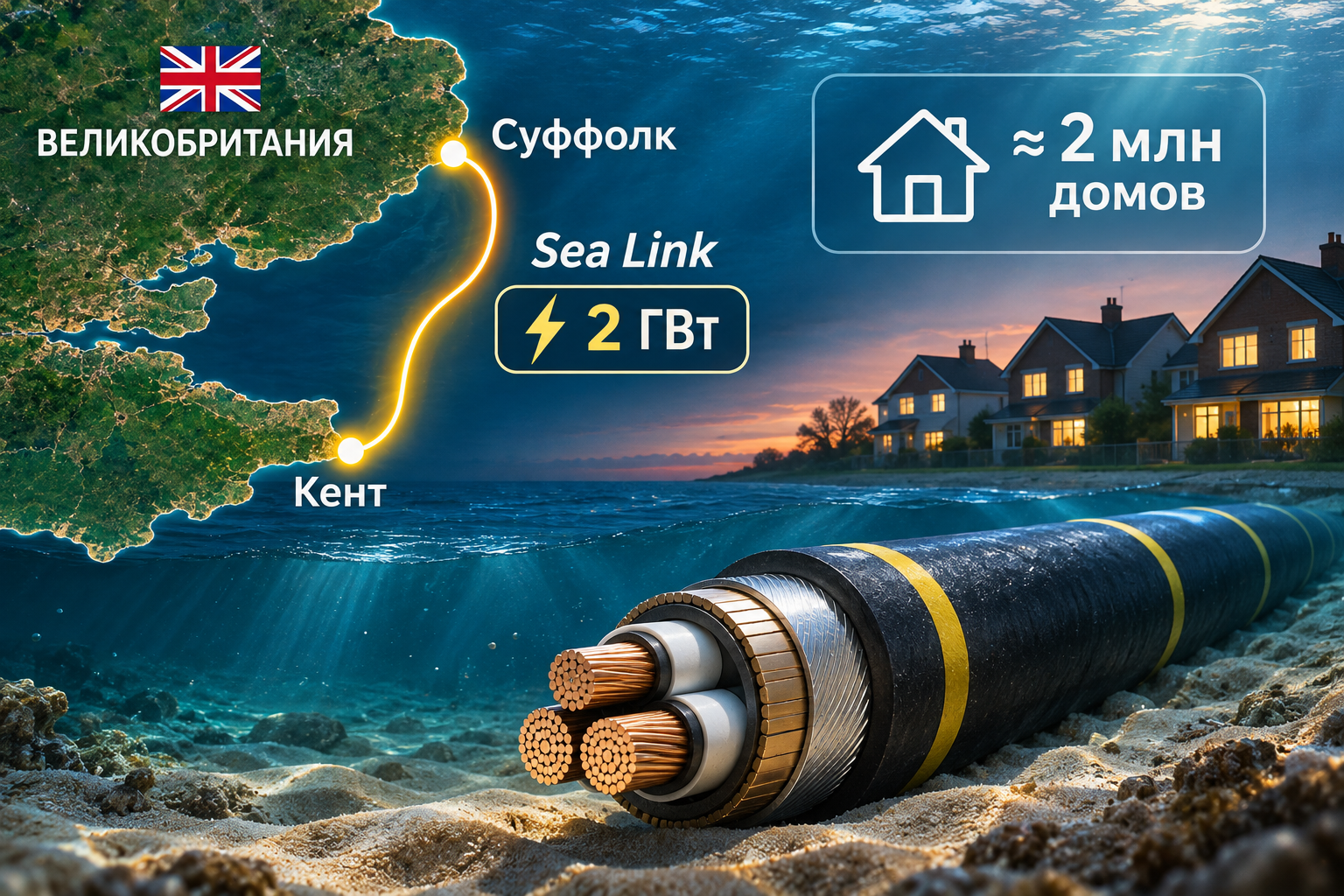
Its capacity is 2 gigawatts (GW), which, according to the developer National Grid, is enough to supply electricity to approximately 2 million homes, the Department for Energy Security and Net Zero reported.
The gist in brief
- Sea Link received construction permission on October 30, 2026.
- The line's capacity is 2 GW, its length is about 138 km, of which approximately 122 km run underwater.
- National Grid expects work to begin in early 2027.
- Shortly before this, the government approved two solar power plants, one of them with a capacity of 800 MW.
What exactly was approved
Sea Link is a transmission line that runs mainly underwater and connects the grids of Suffolk and Kent. It does not generate electricity but transmits it, and in either direction. According to National Grid, new infrastructure will be built on land for the project: substations, converter stations (which convert current for transmission through the cable), underground and overhead lines. According to National Grid's plan, construction will take place in 2026-2031.
Why the line is needed
The government links the project to energy security and grid resilience. The line is expected to reduce energy losses, lower consumer costs and cut the cases where generators are paid to switch off because the grid cannot accept their electricity. National Grid explains the need for the project by the fact that the 1960s grid was designed for coal-fired power plants, while electricity demand is forecast to grow by 50% by 2035 and double by 2050.
"Britain's future depends on rebuilding our national energy system so that renewable energy sources and businesses can interact, driving economic growth and reducing our dependence on volatile global fossil fuel markets that drive up all our electricity bills.
By rebuilding the UK's electricity grids, we will ensure that homegrown electricity is delivered where it is needed, guarantee the resilience of the energy system in the future and permanently lower electricity bills," said Energy Minister Michael Shanks.
What else the government decided
The decision relies on the creation of the Great British Grid, a state body within Great British Energy that will pool public and private investment to modernize the grid. The government is also preparing a connections reform: developers and businesses will be able to create their own grid connections if necessary to reduce delays and costs.
For residents of Kent and Suffolk, National Grid is launching a scheme under which local community funds will receive more than £1 million each. The money can be directed to community facilities, green spaces and local skills training.
Which solar plants were approved before the cable decision
The Sea Link decision was preceded by the approval of two solar power plants. Great North Road Solar and Biodiversity Park near Newark in Nottinghamshire is designed for 800 megawatts (MW), which, according to the developer Element Green, will be enough for approximately 400,000 homes per year. Together with Springwell Solar Farm, approved earlier this year, it will become the country's largest solar farm. About 4,000 sheep will graze under the panels, and up to 9,000 during lambing; in addition, 64,500 trees will be planted and 34.8 km of walking and riding routes will be laid out.
The second station, Frodsham Solar in Cheshire, combines solar panels with batteries for energy storage and, according to the developer, will provide electricity to about 40,000 homes. Since July 2024, the government has approved 39 nationally significant clean energy projects.
What is happening with underwater cables in the Caspian region
In Kazakhstan, a fiber-optic line from Aktau to Sumgait has already been launched along the bottom of the Caspian Sea. It was laid by Kazakhtelecom and AzerTelecom International through the joint venture CaspiLink B.V. using their own funds; the cable contains 64 optical fibers, and its design capacity exceeds 400 Tbps. It was reported that the marine stage of laying was the most difficult.
With an electric cable along the bottom of the Caspian, things are different: the project for a green corridor from Central Asia to Europe so far exists only on paper. The Green Corridor Alliance, created by the system operators of Kazakhstan, Azerbaijan and Uzbekistan, signed a memorandum with Germany's Siemens Energy, but it contains no specific obligations. A feasibility study is planned to be completed in May 2027; its cost of about €1 million is covered by grants from the Asian Development Bank and the Asian Infrastructure Investment Bank. The volume of supplies has not yet been determined: the Uzbek minister mentioned a range of 2-5 GW.
Further west, on the Caspian - Black Sea - Europe section, matters have progressed further: the green energy corridor has completed the feasibility study stage and moved to preparation for implementation, but there is no final investment decision yet. Kazakhstan, Azerbaijan, Georgia and Romania sent a letter to EU Energy Commissioner Dan Jørgensen asking for the corridor to be included in the EU's third list of projects of mutual and common interest.
Author's conclusion
The almost simultaneous approval of the cable and large solar farms shows that one of the main bottlenecks in British energy is not generation but transmission. The grid cannot keep up with accepting all the electricity produced, so generators have to be paid for idling. Sea Link solves this problem at 2 GW, but the result will have to wait: work will begin only in 2027, and National Grid plans to complete it by 2031. Minister Michael Shanks's promise to lower bills "permanently" remains a political statement rather than a calculation: neither the government's release nor National Grid's materials contain an estimate of savings for consumers.

Comments ()