Swiss startup with solar panels directly between the rails proves successful
A year ago, Swiss startup Sun-Ways installed 48 solar panels between rails on a 100m track in Buttes. Over 11,000 trains passed without a single serious incident.
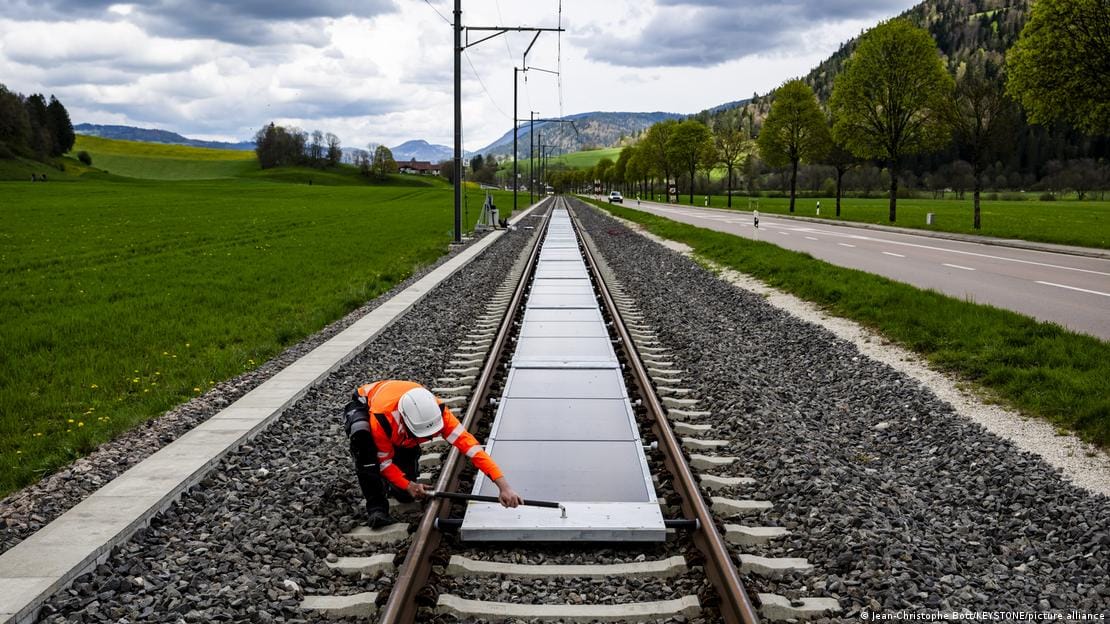
Output at the experimental site for the year — 16,000 kWh, with no scheduled maintenance required. As Euronews reports, the three-year experiment could become a permanent system right now. Next stations — Italy, South Korea, France, the Netherlands, China, India, and Singapore. For Kazakhstan, with its thousands of kilometers of railways in sunny regions, this is a technology deserving close attention.
The Gist in Brief
- The Sun-Ways solar railway in Bütte (Canton of Neuchâtel) was launched on April 24, 2025. The installation capacity is 18 kW, with 48 panels on a 100-meter section of an active line.
- In the first year, over 11,000 trains passed over the panels at speeds up to 90 km/h. The installation remained stable and safe. Fears regarding glare for train drivers were unfounded — not a single complaint from personnel.
- Annual output — over 16,000 kWh: the yearly consumption of 3–4 Swiss households. The electricity feeds into the local grid; in the future — direct supply to the train traction network.
- If the entire Swiss railway network were covered (5,317 km, excluding tunnels), potential output would be 1 TWh per year — about 2% of the country's energy consumption, enough for 300,000 households.
- Sun-Ways has signed cooperation agreements with France (SNCF) and Italy, received approval from South Korean authorities, and is in talks with the Netherlands, China, India, and Singapore.
How It Works — And Why It's Not as Simple as It Seems
The idea is simple to the point of being obvious: between the rails of every railway in the world runs a strip of free space — it's unused, well-lit, and already equipped with infrastructure. Why not lay solar panels there?
In practice, the railway environment is extremely harsh: vibration from thousands of trains, ballast gravel, metal particles, dust, snow, and the air pressure wave from passing trains. The International Union of Railways had previously pointed out risks: micro-cracks in panels, potential fires, and glare for drivers.
Sun-Ways solved these problems with an engineering approach: the panels are made from more durable materials than rooftop panels, coated with an anti-glare filter, and equipped with built-in sensors. Trains are fitted with brushes on their ends that clean the panel surface with every pass. Crucially, the panels are removable — when track maintenance is needed, a special machine removes them "like a carpet."
A Year of Operation: The Numbers Speak for Themselves
Over 11,000 trains have passed over the 100-meter section in Bütte since it was commissioned a year ago. The installation has proven completely stable and safe.
Regional transport operator TransN confirmed: the solar system between the rails did not interfere with daily railway operations. "There were no conflicts with infrastructure, maintenance, or train traffic."
Sun-Ways founder Joseph Scuderi summarized: "We achieved our goals — both in terms of railway safety and electricity production." The results are so encouraging that regional authorities are considering transitioning from the pilot to a permanent installation — without waiting for the planned three-year experiment to end in 2028.
The Ambition: A Train Powered by Its Own Energy
Currently, electricity from the pilot site goes into the local grid.
But the ultimate goal of Sun-Ways is fundamentally different: "In the long term, our ambition is to produce energy between the rails and feed it into the train's traction current, making them practically self-propelled."
For now, this is a distant prospect — the pilot's capacity is too small. But the scale of the world's railway networks makes the idea attractive: long, open corridors of space between rails exist on railway lines worldwide.
The Main Technical Limitation
The key challenge to be solved for scaling is the electrical architecture. Professor Julien Pouget from the University of Applied Sciences and Arts Western Switzerland Valais points out: for sections longer than 500 meters, existing technologies are unsuitable — the voltage needs to be raised to a high-voltage level for long-distance transmission. This is an unresolved engineering problem that Sun-Ways is dedicating separate scientific research to.
The Kazakhstan Context
Kazakhstan has over 16,000 km of railways, a significant portion of which runs through open steppe with high solar potential — especially in the south and center of the country. Kazakhstan's railways bear enormous electricity costs for traction, and finding ways to reduce this dependence remains relevant.
The Sun-Ways technology offers the use of the existing railway right-of-way land — without requiring additional land acquisition and without competing with agricultural use. For KTZ and renewable energy regulators in Kazakhstan, this direction is at least worth adding to the register of promising technologies for monitoring.
Author's Conclusion
The solar railway in Bütte currently operates on 100 meters and powers three households. But a precedent has been set: trains can run over solar panels without accidents or incidents — and a year of real-world operation has confirmed this. Now the task is scaling up and solving the technical issues with high-voltage transmission. If Sun-Ways succeeds, the world's railway networks will turn into one of the largest potential sites for solar generation. Without a single square meter of additional land.

Comments ()