Temperature record of 111 years broken in Kazakhstan
July 2026 will long be remembered in Kazakhstan's weather records: Kazhydromet reports temperature records broken in several regions, some standing for over a century.
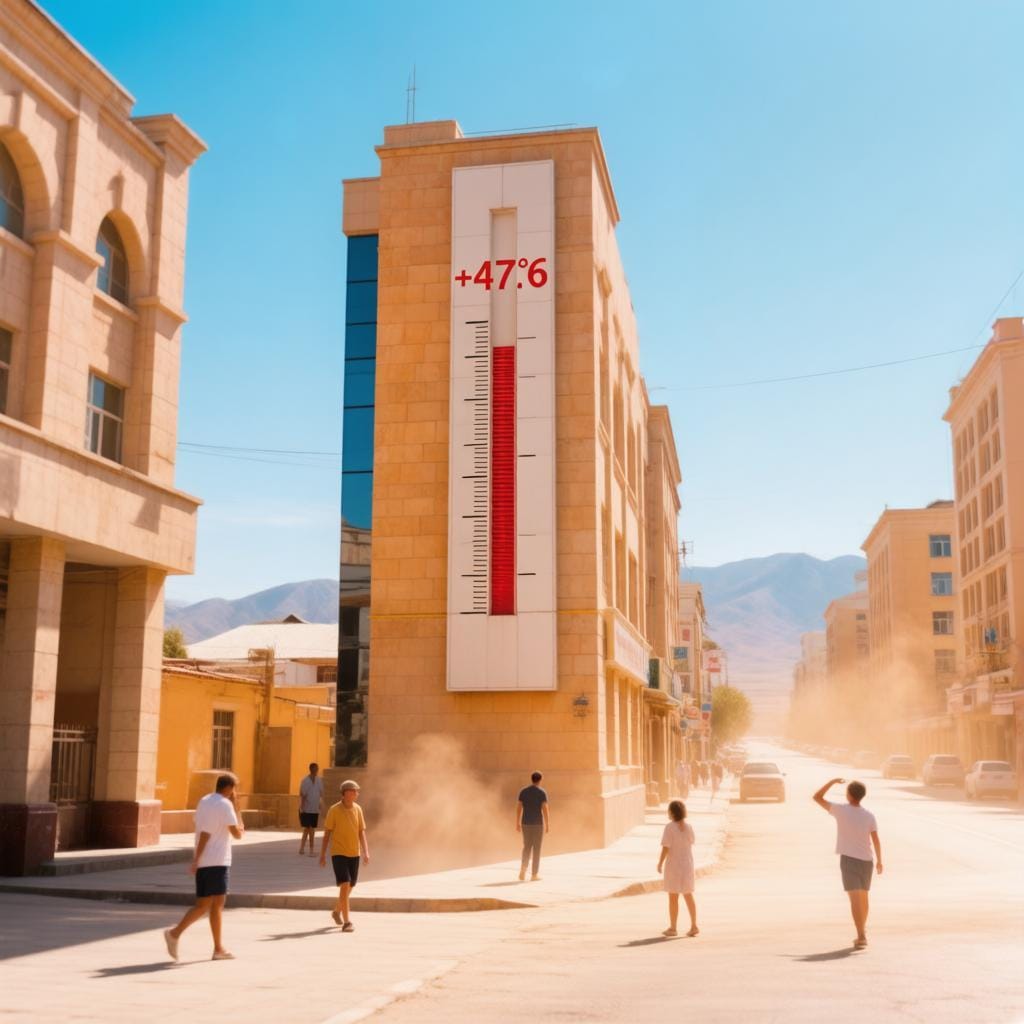
In Turkistan, the air warmed up to +47.6°C, and in Shymkent, a record set back in 1915 was broken, reports Tengrinews.kz.
The gist in brief
- On July 18, +47.6°C was recorded in Turkistan — a new absolute record, surpassing the 2019 figure (+43.7°C) by as much as 3.9 degrees.
- In Shymkent, from July 16–20, the air warmed up to +45.2°C, breaking records from 1915 — 111 years ago.
- In Almaty, over five days, from July 16 to 20, four consecutive temperature records were updated, reaching +41.5°C — the previous record from 2007 was +39.5°C.
- Astana experienced its hottest day in 34 years — +38.6°C compared to the 1992 record of +35.3°C, and the probability that the entire year of 2026 will be the warmest in the history of observations has sharply increased.
Records across the country
The geography of the anomaly proved to be extremely wide — from the south to the north and east of the country. In Almaty, the hottest period was from July 16 to 20: on the 16th, the temperature rose to +38°C, exceeding the 2015 figure; on the 17th, the air warmed to +39.2°C, breaking the 1945 record; on the 18th, +40°C was recorded, higher than the 1997 record; and on the 20th, thermometers showed +41.5°C, updating the 2007 record. In the east of the country, in Ust-Kamenogorsk, +34.4°C was recorded on July 2 — above the 1969 record, and already on July 16 the temperature reached +39.7°C, again exceeding the figure of the same 1969. In Kyzylorda, on July 17, the air warmed to +45.2°C, breaking the 2015 record of +43.6°C.
Heat and downpours simultaneously
A feature of this July is not only the record heat, but also the extremely uneven distribution of precipitation. According to Kazhydromet, air temperatures across most of Kazakhstan in July were 1–4 degrees above normal, while precipitation amounts in most regions remained at or below normal. But in some areas, the exact opposite occurred: in Zhetysai, Turkistan Region, the monthly precipitation norm (just 1 mm) was exceeded 15 times, and in Presnogorkovka, Kostanay Region, 70 mm of precipitation fell on July 20 against a norm of 59 mm. Similar localized downpours, exceeding the norm by two to four times, were also recorded in Taraz, Saryshagan in Karaganda Region, Chingirlau in West Kazakhstan Region, and Makhambet in Atyrau Region — meaning heat and pinpoint extreme precipitation occurred almost simultaneously in different parts of the country.
Part of the global picture
Kazakhstan's record July is not an isolated national phenomenon, but part of the same global anomaly that climatologists are recording around the world. July 2026 became the second hottest month in the history of observations on the planet, and Kazakhstan was among the countries where the average monthly temperature set an absolute record. We have already written that NOAA has raised the probability that the El Niño forming this year will become the strongest in the history of observations to nearly 70% — it is with this phenomenon that climatologists associate the increased risk of heat waves in Central Asia, which was written about earlier this year. A similar picture — record heat mixed with localized extreme downpours — was observed this summer in Europe, where anomalous heat turned into a crisis for agriculture across an entire continent.
Author's conclusion
The 111-year-old record is not just a curious detail of the weather report, but an indicator of how far beyond the usual climate norm this July has gone. When several cities across the country update records set decades and even a century ago in a single month, it speaks not of a random anomalous day, but of a shift in the climate baseline itself, onto which local effects are then superimposed — extreme heat in some places, and, paradoxically, downpours several times above the norm in others.


Comments ()