The Netherlands launches Europe's largest CO2 capture project.
Norwegian firm Yara International has launched Europe's largest CO2 capture and storage facility — not at a power plant, but at one of Europe's biggest ammonia and fertilizer plants.
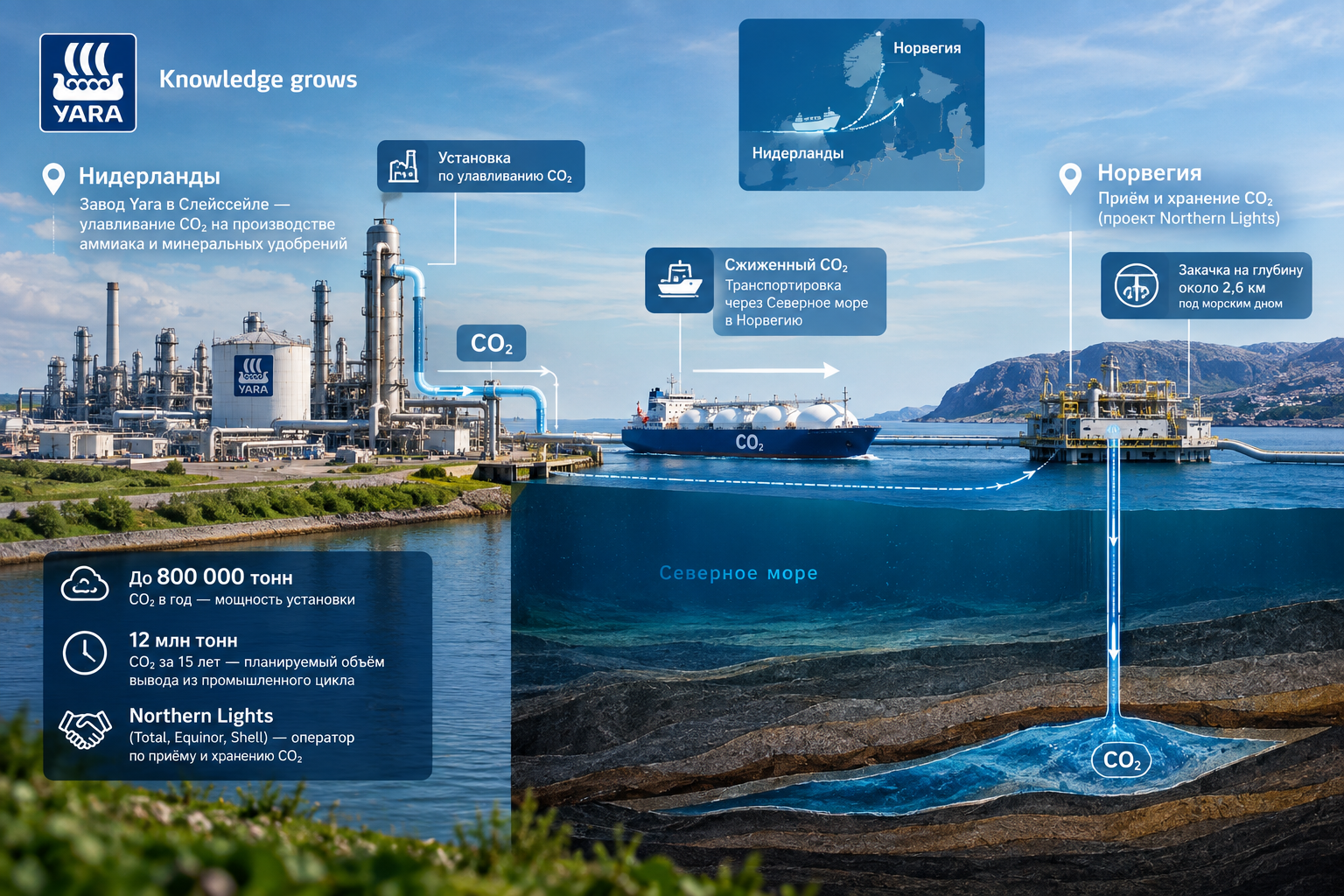
The captured gas will literally travel across the border — to Norway, where it will permanently settle at depth beneath the seabed.
The gist in brief
- Company Yara International has commissioned Europe's largest carbon capture and storage (CCS) facility at its plant in Sluiskil, the Netherlands — one of Europe's largest production sites for ammonia and mineral fertilizers.
- The captured CO₂ will be liquefied and transported via a cross-border chain to Norway, where it will be injected to a depth of about 2.6 km beneath the seabed on the continental shelf; the facility's capacity is up to 800,000 tonnes of CO₂ per year.
- Over 15 years of operation, Yara expects to remove about 12 million tonnes of CO₂ from the industrial cycle; reception and storage are provided by operator Northern Lights — a joint venture of Total, Equinor and Shell.
- The project has become the world's first commercial cross-border CO₂ transport and storage chain — a binding agreement between Yara and Northern Lights was signed back in 2023.
How the cross-border chain works
The distinguishing feature of the Yara project is not the capture technology itself as such, but precisely the cross-border logistics. Carbon dioxide is captured directly at the industrial site in the Netherlands, then liquefied and shipped by sea across the state border to Norway — into the Northern Lights infrastructure, from where it is injected into geological formations beneath the North Sea floor. Neither capture nor storage individually is new to the industry, but it is the combination of "capture in one country — permanent storage in another" that had not previously been implemented on a commercial basis.
Northern Lights — infrastructure for all of Europe
Northern Lights is part of the larger Norwegian Longship project, 80% funded by the state. The first phase with a capacity of 1.5 million tonnes of CO₂ per year is already fully booked by clients across Europe, and operators are considering expanding capacity to more than 5 million tonnes per year. It is precisely this logic — not building a dedicated storage site at each individual industrial facility, but creating shared infrastructure that different companies from different countries can connect to — that makes Northern Lights a potential model for all of European industry, not just for a single Yara plant.
Why this matters for Kazakhstan
The industry in which Yara operates — ammonia and mineral fertilizer production — is already familiar to hunn.kz readers: we have written about how Kazakhstan is building its own full-cycle fertilizer production, including the large chemical complex "KazAzot Prime" in the Mangystau region. Ammonia production is technologically linked to significant CO₂ emissions, which means the issue of carbon capture and storage will sooner or later face Kazakhstani projects of this profile as well — especially given that the country is simultaneously developing its own carbon unit market, allowing farmers to earn up to $40 per tonne of CO₂ through regenerative agriculture. A similar logic of monetizing climate impact can be seen in another Kazakhstani story: scientists have calculated that the dried-up bed of the Aral Sea has released 748 million tonnes of CO₂ into the atmosphere, and have proposed financing the restoration of the water body precisely through the sale of carbon credits. The Yara experience shows that for energy-intensive chemical industries, CCS is not a futuristic technology but an already commercially operating practice, albeit still on a scale unattainable for most countries without similar interstate infrastructure.
Author's conclusion
The Yara project demonstrates that the fight against industrial carbon emissions is moving from the stage of declarations to the stage of concrete, commercially operating infrastructure — with cross-border supply chains, booked capacities, and expansion plans years ahead. For countries like Kazakhstan, whose economy relies heavily on energy-intensive industry — from oil refining to fertilizer and metals production — the Norwegian-Dutch example matters not as a reason for immediate copying, but as a benchmark: carbon capture and storage technology has reached the stage where its economics and logistics can already be studied on a working, not hypothetical, example.
Comments ()