The state has been putting the loss-making herbicide plant up for auction for the second year in a row
A year ago, there were no buyers for this asset at all.
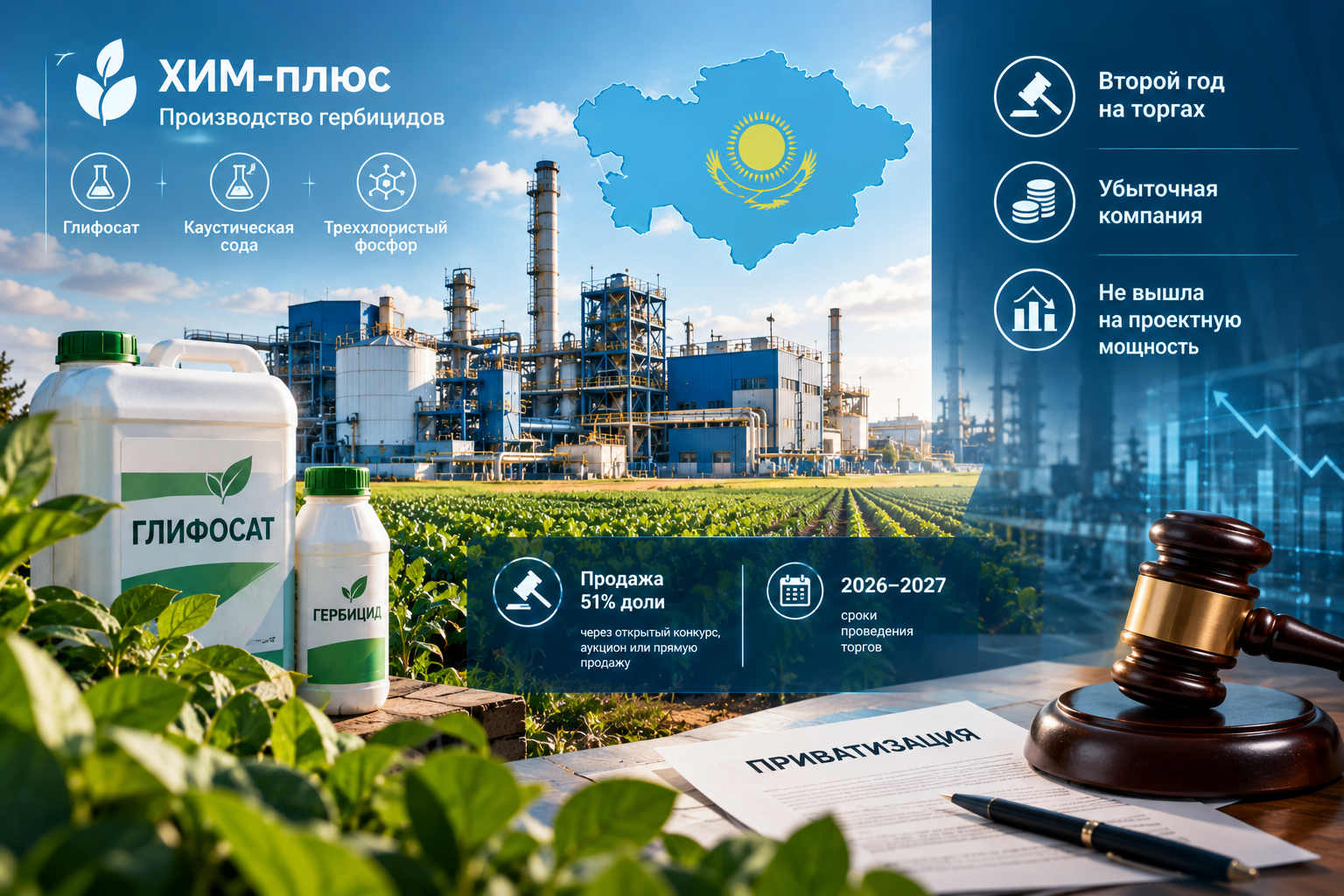
Now the government is making a second attempt to get rid of the company that was supposed to become one of the large domestic producers of plant protection products, but never reached its design capacity.
The essence in brief
- According to the officially published Resolution of the Government of the Republic of Kazakhstan No. 824 dated September 17, 2026, the stake in KhIM-plus LLP has been included in the list of assets proposed for transfer to a competitive environment; the sale is planned for 2026–2027 through an open two-stage tender, electronic tender, auction, or direct targeted sale.
- The same resolution adds another company to the list — GPC Investment LLP, a subsidiary of National Company QazaqGaz JSC, which is planned to be sold within the same timeframe through a direct targeted sale.
- KhIM-plus is the operator of the project complex "Glyphosate Production," "Caustic Soda Production," and "Phosphorus Trichloride Production" in Zhambyl Region, a subsidiary of Samruk-Kazyna Ondeu LLP.
- The company remains loss-making and has still not reached its design capacity, calculated for the output of about 2.9 million liters of liquid and 2 million kg of granular glyphosate-containing herbicide per year.
- This is already the second privatization attempt: the auction in August 2025 did not take place, since the asset did not attract interest from market participants.
What stands behind last year's failure
The failure of last year's auction is a telling detail in itself: even a large production complex with ready infrastructure and the status of one of Kazakhstan's key projects for the production of plant protection products did not interest a single potential buyer. The official reason for the auction's failure is not disclosed in the resolution itself, but two factors mentioned in related publications — loss-making operations and failure to reach design capacity — by themselves explain investors' caution: few are ready to acquire a stake in an enterprise that has been unable to reach its planned indicators for years.
Glyphosate is not abstract chemistry, but part of the agrochemical market
KhIM-plus's products are not narrowly specialized chemicals, but one of the most widely used herbicides in global agriculture. We have already written that a global study links pesticide exposure to hundreds of millions of cases of farmer poisoning annually, and Kazakhstan's plant protection products market remains an area where almost 38% of registered preparations belong to the especially hazardous category. The fate of the domestic glyphosate producer in this context is not merely a question of privatizing a single asset, but part of a broader picture of what the Kazakhstani market of chemical plant protection products is formed from and how — through imports or domestic, albeit still loss-making, production.
Part of a broader picture with fertilizers
The story of KhIM-plus echoes another line already familiar to us — the fate of Kazakhstani producers of mineral fertilizers. We wrote that Kostanay farmers cannot obtain subsidized domestic fertilizers for months, since plants prefer to export products abroad, while export statistics meanwhile show that supplies to certain countries grew multiple times even amid an overall decline in volumes. In parallel, Kazakhstan is building a full cycle of fertilizer production — from organics to export nitrogen, striving to shed raw-material dependence in the chemical industry. The KhIM-plus case is the mirror side of the same sector: if fertilizer producers struggle with the problem of excessive exports to the detriment of the domestic market, then the herbicide producer, by contrast, cannot even reach its own design capacity and for the second year in a row cannot find a buyer.
The link to the soil protection law
The fate of domestic production of plant protection products acquires additional significance against the backdrop of the law "On Soil Protection" that has come into force, obliging landowners to take measures to preserve fertility and prevent land degradation. Chemical plant protection products are an integral part of modern agriculture, and whether the country provides its own production of such products or depends entirely on imports directly affects the availability and cost of agrochemicals for farmers, who are now obliged to comply with stricter requirements for the condition of their lands.
Author's conclusion
The repeated attempt to privatize KhIM-plus is a practical test of whether the asset's market attractiveness has changed over the past year, or whether the enterprise will again remain without a buyer. While the company is loss-making and has not reached design capacity, the probability of repeating last year's scenario remains high — unless the state adjusts the sale terms or offers additional incentives for investors. It is telling that the same resolution adds GPC Investment — a subsidiary of QazaqGaz — to the list for sale, meaning KhIM-plus is not the only asset whose fate the state decided to revisit this very autumn. For Kazakhstan's agrochemical industry as a whole, the KhIM-plus case is a reminder that creating domestic production of chemical plant protection products remains a far more difficult task than adopting the corresponding government decisions on paper.
Comments ()