The world's largest hybrid solar plant launched in the Gobi Desert — it works at night without batteries
China Three Gorges Corporation (CTG) has launched the world's largest hybrid energy complex in Hami, Xinjiang, with a 1,000 MW capacity, now in commercial operation.
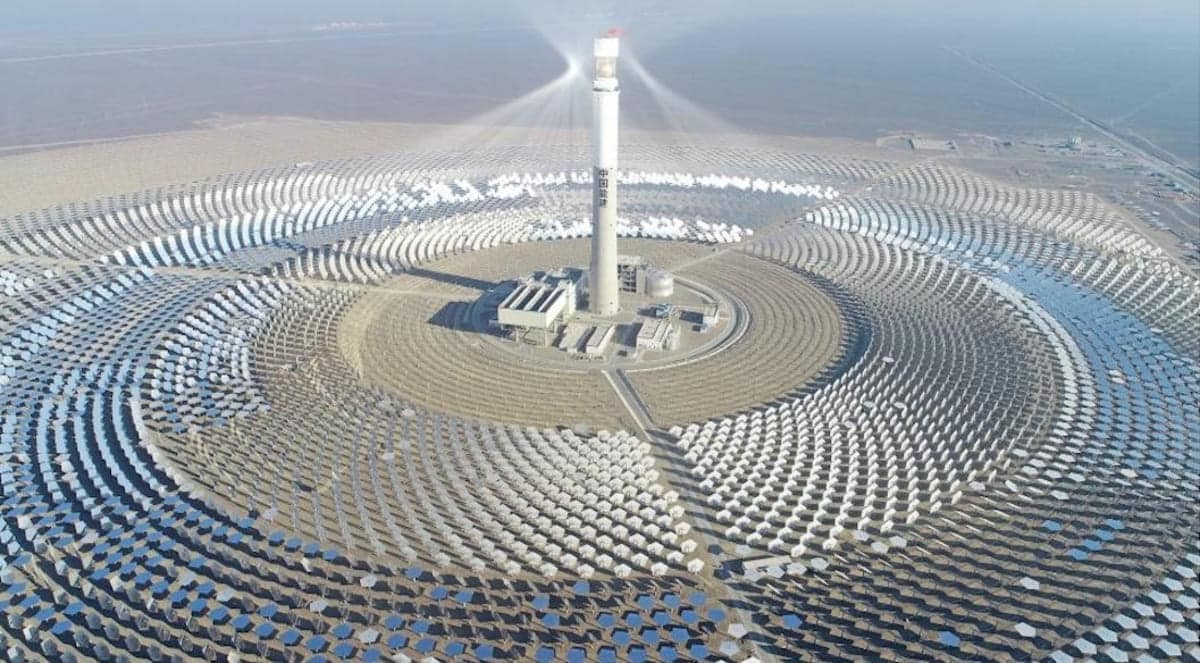
The main feature is that the station continues to generate electricity for up to 8 hours after sunset without using lithium-ion batteries, reports Naked Science. Instead, it uses molten salt heated to 550°C. For Kazakhstan, which is actively building solar facilities and discussing the future of nuclear power, this technology offers a competitive alternative for solving the problem of nighttime power supply.
The Gist
- The complex is located at the southern foot of the Tien Shan mountains in the Hami region, occupies 1,817 hectares, and has been operating in commercial trial mode since July 1, 2026. It was connected to the grid on September 18, 2025, and has since transmitted 6.54 million kWh of electricity.
- Capacity structure: 900 MW from traditional solar photovoltaic panels, 100 MW from a concentrated solar power (CSP) plant with molten salt storage.
- The CSP unit uses 260,000 movable mirrors across an area of 800,000 m² — they concentrate sunlight, heating the salt to 550°C. The stored heat is used to produce steam and generate electricity for up to 8 hours after sunset.
- Annual output upon reaching full capacity is about 2,070,000 MWh, enough for 830,000 households. CO₂ emission reduction is 1.63 million tons per year.
- CTG is already planning a second phase in Hami — expanding to 3,000 MW. Meanwhile, China Energy Engineering Corporation is building a neighboring complex with a capacity of 1,500 MW.
How It Works: Two Suns in One Station
The Hami complex combines two fundamentally different generation technologies, both using the same fuel — sunlight — but in different ways.
The first is the familiar photovoltaic panels with a capacity of 900 MW: they directly convert light into electricity and feed it into the grid in real time. They do not work at night.
The second is a concentrated solar power (CSP) plant with a capacity of 100 MW: 260,000 heliostat mirrors focus rays onto a central receiver, heating molten salt to 550°C. The heat is stored in special tanks — and after sunset, it continues to produce steam that drives a turbine for up to 8 hours. This unit solves the main problem of solar energy: dependence on daylight.
CTG has improved the linear Fresnel reflector technology, increasing heat conversion efficiency by about 10% compared to traditional systems. The installation is divided into 46 independent loops — this allows maintenance of individual sections without shutting down the entire station.
Molten Salt vs. Batteries: Economics Decides
The technology of storing energy in molten salt is not new — it is used at several facilities in Spain, the USA, and the UAE. The previous world leader was the hybrid Noor Energy 1 station with a capacity of 950 MW in Dubai. Hami has surpassed it.
However, the technology has a fundamental unresolved issue: cost. CSP has historically been more expensive than traditional solar stations combined with lithium-ion batteries — and battery costs continue to decline. Therefore, the main intrigue is not about the technology's viability — that is proven. The question is whether molten salt storage will be more cost-effective than batteries in the long term as battery prices drop.
China is making a serious bet on this: CTG is already designing the second phase of Hami, and the neighboring 1,500 MW complex is under construction. Scale of production is the best way to reduce costs.
Kazakhstan Context
Kazakhstan is building solar facilities in its steppe regions — Zhambyl, Turkestan, and Karaganda regions. The main limitation of all solar generation is that it does not work at night, leaving evening peak demand unmet.
Today, this problem is solved in two ways: battery storage (like in the Masdar wind farm in the Zhambyl region — 600 MWh) or backup coal and gas generation. Molten salt technology represents a third path, not yet seriously considered by Kazakhstani designers. The Hami precedent is the world's first large-scale, evidence-based case of its industrial applicability.
Xinjiang, where the station is located, borders Kazakhstan and has similar climatic conditions: high solar insolation, large daily temperature differences, and remoteness from major consumers. This further increases the practical value of the Chinese experience for Kazakhstani energy professionals.
Author's Conclusion
The Hami station is not just a capacity record, but a demonstration of a new standard for solar generation: operating around the clock without nuclear fuel and without batteries. Molten salt technology has been known for a long time, but this scale makes it commercially tangible for the first time. For Kazakhstan, which is building a new energy system and seeking a balance between renewables and base load, the Hami experience is worth studying — not as an exotic curiosity, but as a working model.

Comments ()