Tokayev confirmed: field work near Balkhash is being completed — Russia is building the nuclear power plant
President Tokayev said field work at the Balkhash lake site is wrapping up. Rosatom chief Alexei Likhachev earlier announced plans to start active construction in 2027.
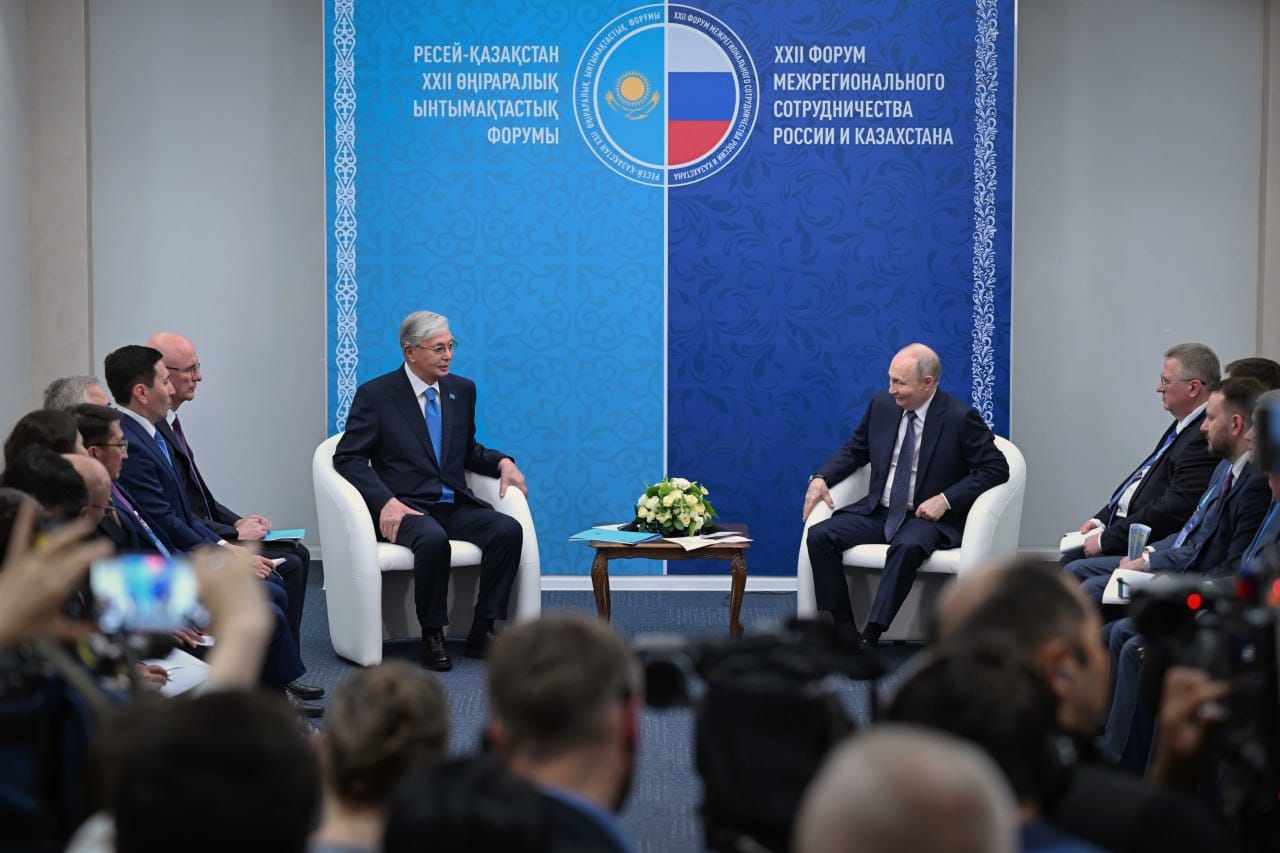
At a meeting with Russian President Vladimir Putin in Omsk during the XXII Forum of Interregional Cooperation, Kazakh President Kassym-Jomart Tokayev announced that field work at the site of the future NPP near Lake Balkhash is being completed. Simultaneously, the parties signed two intergovernmental agreements — on the principles of cooperation for the construction of the plant and on the provision of a Russian state export credit to finance it. The choice has been made: Rosatom has become the partner for Kazakhstan's first nuclear power plant.
The Gist in Brief
- Kazakhstan and Russia exchanged intergovernmental agreements on cooperation for the construction of the NPP and on the provision of a Russian state export credit covering the "major portion" of capital investments.
- President Tokayev stated that field work at the site near Lake Balkhash is being completed. Rosatom head Alexey Likhachev previously announced plans to begin the active construction phase in 2027.
- The Russian credit will cover the majority of the project's cost. Part of the financing remains the responsibility of the Kazakh side.
- Tokayev called the NPP a project that will "bring the peoples of the two countries closer" and ensure the training of Kazakh nuclear personnel with Russian support.
- Trade between the two countries in 2025 amounted to ~$28 billion, Russian investments in Kazakhstan reached ~$30 billion — Russia is becoming the top investor in the Kazakh economy.
The Choice is Made: Rosatom Builds
The referendum on the NPP took place in October 2024 — Kazakh citizens voted "in favor." Since then, the main open question remained the choice of technology and contractor: Rosatom (Russia), EDF (France), KHNP (South Korea), CGNPC (China), and Westinghouse (USA) were involved in negotiations.
The signing of two intergovernmental agreements with Russia in Omsk effectively closes this question. The agreement "On the Basic Principles and Conditions of Cooperation" formalizes the technology partner, while the credit agreement defines the financial model. Without similar documents with other contenders, Rosatom gains formal primacy.
To understand the scale: Rosatom head Alexey Likhachev spoke of starting the active construction phase in 2027. This means less than two years from words to the foundation pit.
Field Work is Being Completed: What This Means
The completion of field work at the site near Balkhash is a technical stage preceding design and construction. It includes engineering-geological surveys, hydrological studies, seismic sounding, environmental assessment, and a number of other mandatory procedures.
Their results will form the basis of the final design solution: the type of foundation, reactor building layout, cooling system, and site-specific positioning on the shore of Balkhash. The fundamental issue of water supply — which we wrote about in the context of French reactors shut down due to river overheating — must be resolved at this stage.
Kazakhstan Sets Course for the Russian Nuclear School
Tokayev specifically highlighted the project's personnel dimension:
"We are talking about training technical personnel with the help of Russia — local, our Kazakh personnel, who would then be capable of working in this very complex field that is the nuclear industry."
This is a fundamentally important signal. We have previously written that the issue of training personnel for the NPP remains the project's main open question — the Atomic Energy Agency acknowledged that a comprehensive plan for specialist training is still being developed. The Russian personnel base through MEPhI and other specialized universities is a ready answer to this challenge, but also a long-term dependence on the Russian nuclear school.
Context: The NPP in the System of Kazakh-Russian Relations
The signing of the agreements did not occur in a vacuum, but against the backdrop of record bilateral indicators: trade — $28 billion per year, Russian investments in Kazakhstan — $30 billion, Russia becoming the top investor. 177 joint industrial projects worth $53 billion — of which 122 have already been implemented.
In this logic, the NPP is the largest single project in the history of bilateral relations. Its scale, implementation timeframe (decades), and credit dependence create a fundamentally new quality of economic linkage between the two countries.
Author's Conclusion
The Omsk meeting between Tokayev and Putin put an end to a question that had remained open for two years: Kazakhstan's first nuclear power plant will be built by Rosatom using a Russian credit near Lake Balkhash. Field work is being completed, and the active construction phase is scheduled for 2027. Now the main questions are not "who" and "where," but "how": how will the water security of Balkhash be organized, how will personnel be trained, and how will Kazakhstan ensure technological independence in operating a plant built with a foreign loan by a foreign contractor.
Comments ()