Triglav Glacier in Slovenia has almost disappeared
One of Slovenia's two glaciers has shrunk to two ice patches totaling under 0.2 hectares — the lowest in 80 years of monitoring.
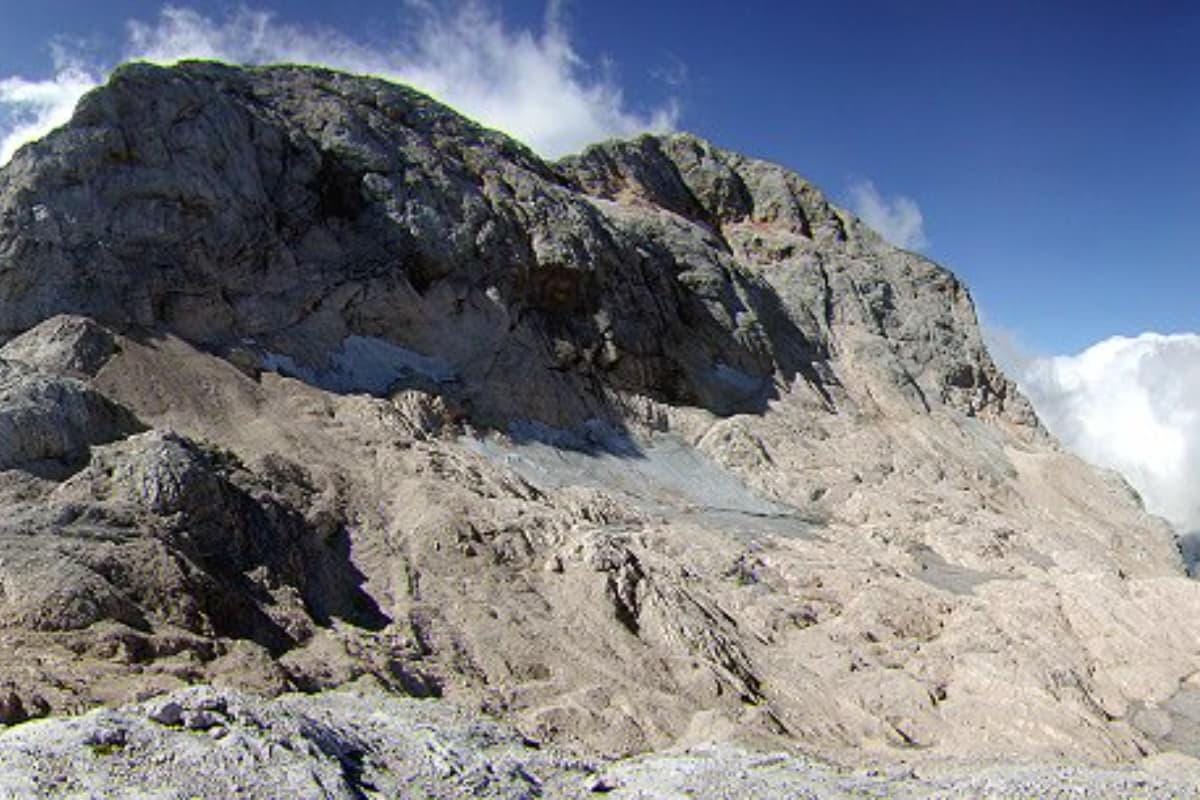
This melting season has become the warmest in 68 years, and researchers believe that the current generation may be the last to see the remnants of the glacier in person.
The gist in brief
- The Triglav Glacier in the Julian Alps has split into two parts, and its combined area has fallen below 0.2 hectares — the smallest figure in the entire history of measurements.
- The 2026 melting season became the warmest in 68 years of observations at the Kredarica weather station; this is already the second consecutive record-warm season, something that has not happened since 1955.
- The age of the ice at the deepest point of the glacier is about 300 years, and the limestone crust beneath it is dated at 13,000 to 23,000 years old.
- The neighboring Skuta Glacier, according to experts' estimates, will last longer, but for years, not decades.
What the latest measurements showed
Geodetic measurements carried out at the end of summer recorded a sharp deterioration in the condition of the Triglav Glacier. It has split into two separate parts, the ice patches are covered with scree, which makes the ice practically invisible to the naked eye. The combined area of the two remaining patches was less than 0.2 hectares, the lowest figure in the entire history of measurements. A year earlier, geologists had found more than five meters of ice at the same spot; this year, only stones were found there.
The reason, according to researchers from the Anton Melik Geographical Institute, lies not in a single anomaly but in a sustained multi-year trend: over the past 70 years, the temperature during the melting period has risen by more than two degrees Celsius, and this is despite the fact that in some years good snow seasons temporarily saved the glacier. This melting season became the warmest in 68 years of observations, and the last two years in a row have been record-warm, something that has not happened since 1955.
Why this is not just a tourism loss
The Triglav Glacier has been systematically studied for 80 years now; this is one of the longest continuous series of glacier observations in the world. As it retreats, it exposes not only bare rock but also its own far more ancient history: the age of the ice at the deepest point was about 300 years, and the limestone crust that formed between the glacier and the rocky base is dated to the period from 13,000 to 23,000 years ago.
The neighboring glacier under Mount Skuta, located in a more shaded spot 400 meters below Triglav, is still in slightly better condition and, according to experts' forecasts, will last at least a few more years. But both glaciers in Slovenia remain the last ones; no others are left in the country, and their possible disappearance would mean not only a symbolic loss but also a shortage of drinking water in summer during dry periods for the rivers they feed.
Part of the global and regional picture
The story of Triglav is not unique; it fits into a far larger process. An international team of polar scientists recently showed that Greenland and Antarctica combined have lost about 12.5 trillion tons of ice over nearly half a century of satellite observations, and the rate of loss is accelerating from decade to decade. This, of course, is a different scale and a different melting mechanism, but the overall vector is the same as that of the small Alpine glacier: the planet's ice is losing mass steadily and at an accelerating pace.
A similar picture is emerging in the mountains of Central Asia. The level of Lake Issyk-Kul in Kyrgyzstan has fallen by almost 14 meters over recent decades against the backdrop of the degradation of the glaciers that feed it, which is why the country's authorities created a special fund to protect them. In Pakistan, in turn, local residents are reviving the centuries-old practice of "glacier grafting," creating artificial water sources to replace retreating natural ones. And in the Alps themselves, on the Tsanfleuron Glacier in Switzerland, researchers are testing sheep's wool coverings as an eco-friendly alternative to synthetic geotextile, which selectively slows melting in the most vulnerable areas. In this sense, Triglav is just one of many Alpine glaciers that researchers are monitoring: we previously wrote about the closure of routes on Mont Blanc and the Matterhorn as a climate signal rather than a tourism problem.
Why this is important for Kazakhstan
Kazakhstan depends on its own mountain glaciers, primarily those of the Tien Shan and the Dzungarian Alatau, as a source of water for irrigation and drinking water supply in the southern regions. The story of Triglav shows, through a compact and well-studied example, exactly what the final stage of a glacier's disappearance looks like: not a gradual, uniform shrinkage, but a sharp acceleration in the final years before complete disappearance, when the glacier splits into fragments and loses its coherence.
The experience of different countries also shows that the response can vary in scale, from institutional (the Kyrgyz fund financed by international donors) to community-based (the Pakistani practice of glacier grafting) and experimental-technological (Swiss wool). For Kazakhstan, which simultaneously depends on glacier melt as a water source and has a large sheep-breeding industry, the Swiss wool experiment looks like a particularly curious precedent: a similar combination of resources and challenges exists here as well.
Author's conclusion
Triglav is interesting precisely because of its small size: unlike the ice sheets of Greenland or Antarctica, its fate can be observed in person and almost in real time, from five meters of ice a year ago to bare stones today. This makes it a kind of indicator, at a level comprehensible on a human scale, of the same process that at the planetary level is measured in trillions of tons. For regions like Central Asia, where the water supply of tens of millions of people directly depends on mountain glaciers, the story of the small Slovenian glacier should be perceived not as a distant tourism news item but as a preview of what may await far larger and so far more resilient glacier systems if current rates of warming continue.
Comments ()