UAE and Kazakhstan to build country's largest wind farm for $1.4 billion
The largest green energy project has launched in southern Kazakhstan.
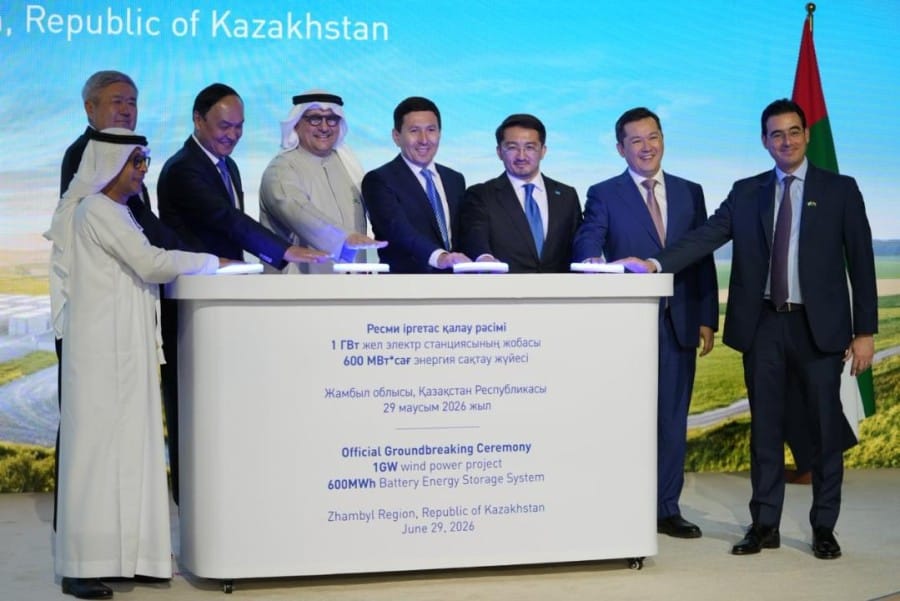
Construction has begun in the Zhambyl region on a wind power plant with a capacity of 1 GW — one of the largest green generation projects in Kazakhstan's history, reports the Ministry of Energy of the Republic of Kazakhstan. Investments amount to approximately $1.4 billion, with the partner being the UAE-based company Masdar. The facility is designed to cover the energy deficit in the southern regions of the country while simultaneously addressing a key issue of renewable energy sources (RES) — generation instability — through an integrated energy storage system.
The Gist
- Implementation of a 1 GW wind power plant worth approximately $1.4 billion has begun in the Zhambyl region. The project aims to cover the energy deficit in the southern regions of the republic.
- The signal to start construction work was given by the Vice Minister of Energy of the Republic of Kazakhstan Sungat Yessimkhanov, Chairman of the Board of Samruk-Kazyna Nurlan Zhakupov, and the head of Masdar Mohamed Jameel Al Ramahi.
- The station will initially be equipped with an energy storage system with a capacity of 300 MW and a capacity of 600 MWh — this solves the problem of predictable energy output regardless of weather conditions and peak loads.
- Consortium structure: Masdar (UAE) — 40%, W Solar — 40%, Qazaq Green Power from the Samruk-Kazyna fund — 18%, Kazakhstan Investment Development Fund (KIDF) — 2%.
- The plant will reduce CO₂ emissions by 2.5 million tons annually. Full commercial operation is scheduled for the third quarter of 2029.
Why a Battery the Size of a Power Plant is Needed
The main technological distinction of the project is not the wind generation itself, but its integration with an energy storage system. Wind is inconsistent: a 1 GW plant without a storage system delivers erratic, hard-to-predict energy to the grid, creating a burden on dispatchers and requiring backup capacity from other stations.
A storage system with 300 MW power and 600 MWh capacity solves this problem directly: excess energy during windy hours is accumulated and released to the grid during peak evening demand or when the wind is calm. This transforms the wind farm from a source of unstable generation into a manageable energy resource — an approach that remains rare for Kazakhstan's RES industry.
Energy Deficit in the South and the Role of the UAE
The southern regions of Kazakhstan — Zhambyl, Turkestan, and Kyzylorda regions — suffer from a chronic energy deficit, partially covered by flows from the north of the country and imports. Local generation with a capacity of 1 GW can significantly change this balance.
Vice Minister of Energy Sungat Yessimkhanov noted: "The partnership with Masdar contributes to the development of renewable energy and Kazakhstan's progress towards carbon neutrality. This project will help strengthen the region's energy security and attract modern technologies to the RES sector."
The participation of Masdar is not the first instance of Emirati capital in Kazakhstan's green energy sector, but this particular project is becoming one of the largest in terms of investment scale and capacity. The Kazakh side's share in the consortium (20% collectively through Qazaq Green Power and KIDF) ensures a certain level of national participation in the management and revenues of the project.
The Long Road to Launch
It is worth noting the realistic timeline: full commercial operation of the complex is scheduled for the third quarter of 2029 — that is, more than three years after the groundbreaking ceremony. This is a typical timeframe for projects of this scale, encompassing design, turbine delivery, construction of grid infrastructure, and commissioning.
The wind farm in the Zhambyl region is an illustrative example of what mature RES infrastructure should look like: not scattered, weather-dependent stations, but complexes with built-in generation management. If the project is implemented within the stated timeframe and the storage parameters are confirmed in practice, it will set a benchmark for subsequent wind and solar projects in Kazakhstan — where energy storage systems remain more of an exception than the standard.
Comments ()