Under solar panels, the vines grew twice as fast, and the berries became less sweet
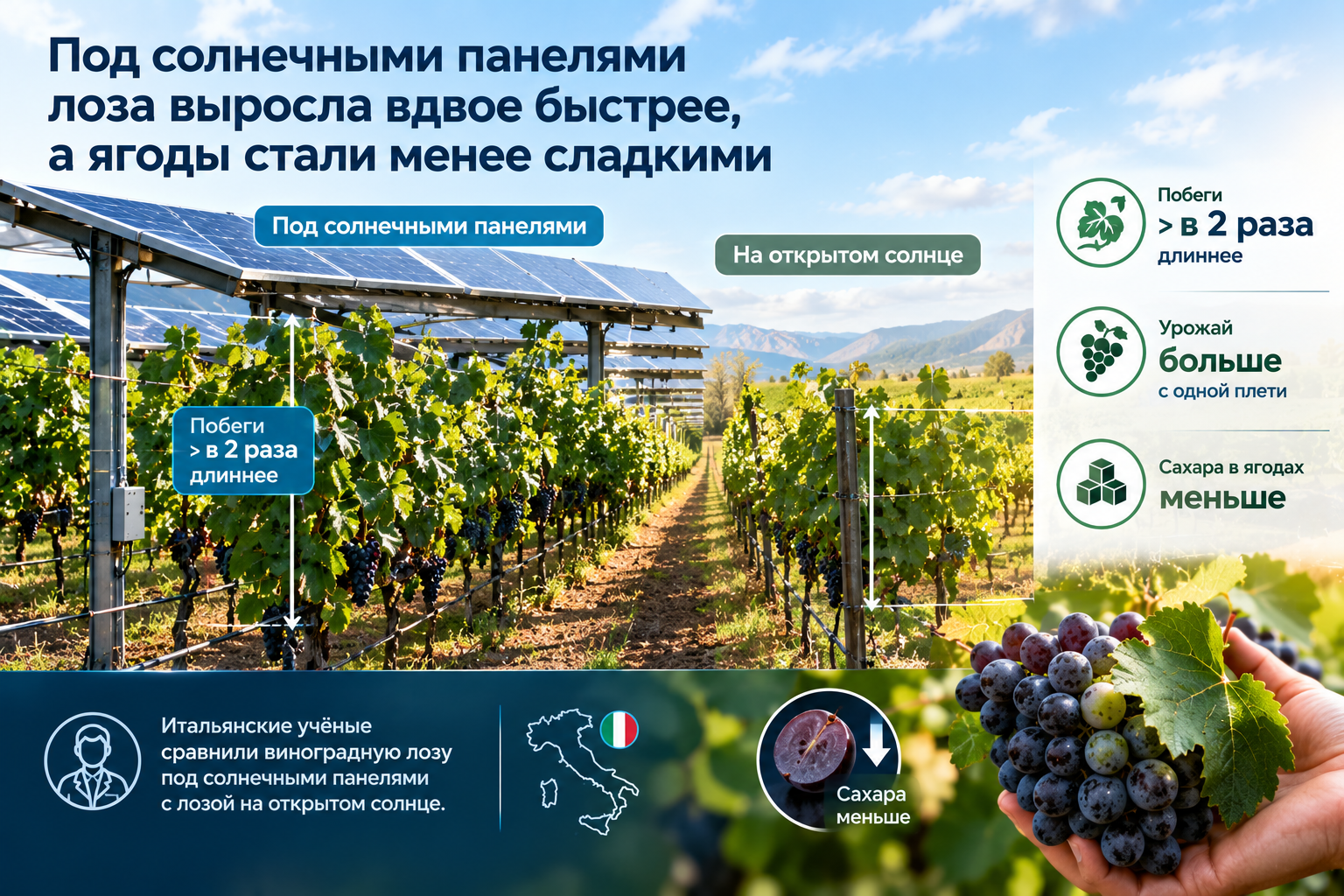
Italian scientists compared grapevines under solar panels with vines in open sun. Shoots under panels grew more than twice as long, yield per vine increased, but sugar in the berries was lower.
The study was published in the journal Scientia Horticulturae.
The gist in brief
- Shoot length under the panels was 267-274 cm versus 115.8 cm in the sun.
- Yield per vine: 0.41 kg without panels, 1.36 kg under weak shading and 1.06 kg under strong shading.
- Berry sugar content was lower: 22.9 °Bx under strong shading versus 25.8 °Bx in the sun.
- Under the panels the air was 0.5-1 °C cooler, and there were twice as many weed species.
What was compared
Observations were carried out during the 2024 season at the commercial solar farm "Le Rene" near Laterza in Italy's Apulia region. Agrivoltaics is the combination of solar power plants with agriculture: crops are grown under or between the panels. The vineyard, covering 1.06 ha, is planted with the eight-year-old Primitivo variety; it is barely irrigated and relies on rainfall. The panels, with a capacity of 350 kW, are raised 2.7 m above the ground. The control plot without panels covers 1828 m².
The vines were compared under three lighting conditions: in open sun, under weak shading (the rows between the panels, about 95% of light) and under strong shading (directly under the panels, about 5% of light). One of the authors of the work was Professor Giuseppe Ferrara of the University of Bari.
What the results were
Shoots in the sun grew on average to 115.8 cm, under weak shading to 267.2 cm, and under strong shading to 274.2 cm. The yield per vine was 0.41 kg in the sun, 1.36 kg under weak shading and 1.06 kg under strong shading. The number of clusters per vine was 4.8 without panels, 8.8 under weak shading and 6.4 under strong shading. The average cluster weight under strong shading was 164.87 g, versus 65.43 g in the sun.
Under the panels the air was 0.5-1 °C cooler, and relative humidity was 2-14% higher. The soil contained more moisture: about 32% versus 26% in the open plot. The vines under the panels also had a better water status: their stems experienced less water stress. In addition, in the plot under the panels the scientists found twice as many species of wild plants as in the control plot.
What is the price of such a result
Berries under the panels accumulate sugar more slowly: 25.8 °Bx in the sun, 24.4 °Bx under weak shading and 22.9 °Bx under strong shading. °Bx (degrees Brix) is the unit used to measure the proportion of sugar in juice. Titratable acidity also decreased: from 7.29 g/l in the sun to 6.51 g/l under weak shading and 6.09 g/l under strong shading. Phenolic compounds, including polyphenols, were most abundant under weak shading (35.22 mg per gram of dry skin), and least abundant under strong shading (23.10 mg).
"Shading slows the accumulation of sugar, and lower temperatures reduce the breakdown of organic acids," explained Ferrara.
The style of the wine also depends on this.
The authors note the limitations: the experiment ran for one season in one vineyard, and the season was cooler than usual. Ferrara emphasizes that the result applies to a hot and dry climate like that of summer Apulia. In northern Italy, in Valpolicella, an earlier study showed the opposite: outside the panel zone the yield was higher. Ferrara calls agrivoltaics "not the only solution, but one of the possible ways to protect agriculture."
What this means for Kazakhstan
Kazakhstan, with its sunny and arid regions, has so far been almost untouched by agrivoltaics. In our material about an American farm in Colorado, we wrote that in the Tashkent region of Uzbekistan a 10-hectare vineyard is being grown under panels with a capacity of 1 MW. This is a project with French investors, and there are no such projects in Kazakhstan yet.
Our large solar power plants are concentrated in the Zhambyl, Turkestan, Kyzylorda and Karaganda regions. A five-year study of two farms in Minnesota showed that under raised panels with native grasses the number of insects tripled. The author of our material believes that such an approach could also be applied to the degraded steppe lands of Kazakhstan.
Author's conclusion
The yield per vine rose from 0.41 kg to 1.36 kg, but this is one season and one vineyard of just over a hectare. There was less sugar in the berries, and for a winemaker this is a question of wine style, not only of quantity.


Comments ()