Uzbekistan pays residents for sunshine — and payments grew 9-fold in a year
In H1 2026, over 68,600 Uzbeks received state subsidies for electricity from home solar panels. Total payouts hit 330.82 billion soums—about 13 billion tenge.
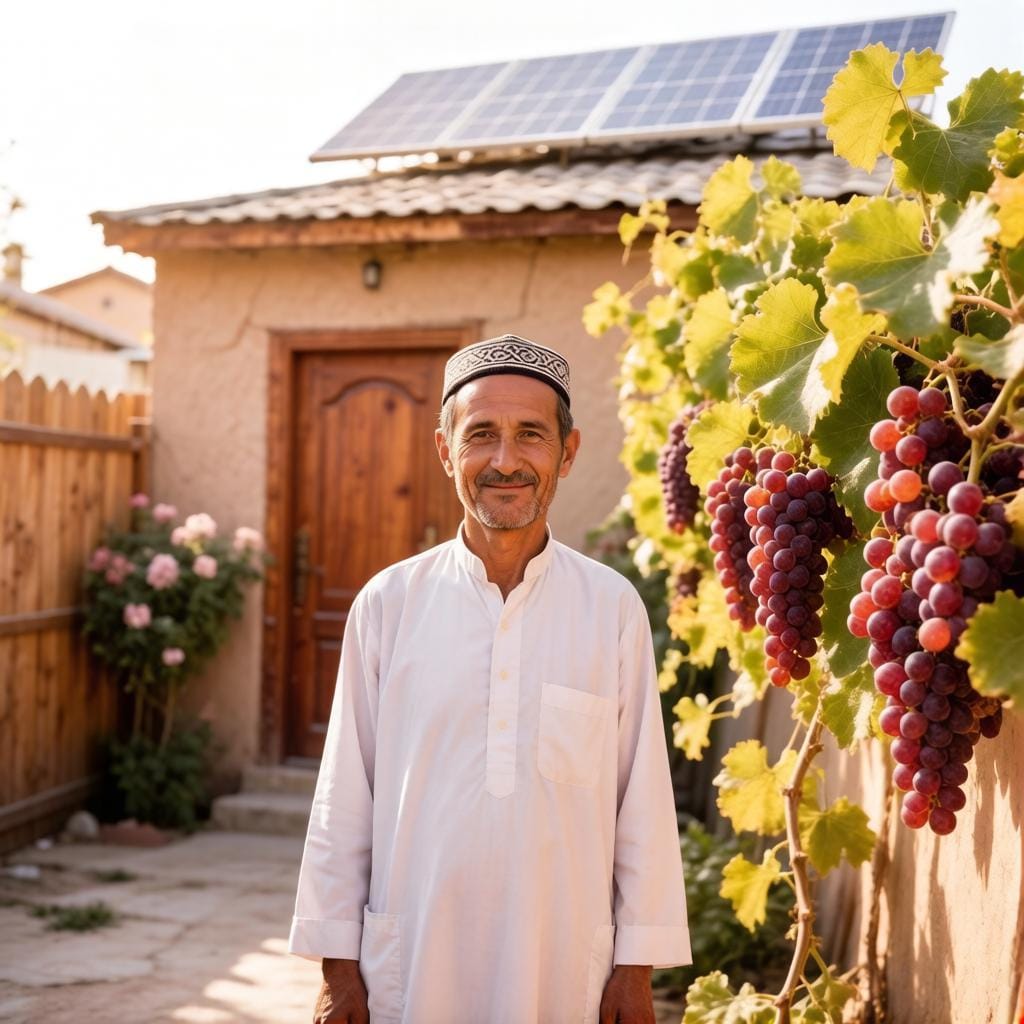
The "Solar House" program has been running for three years now and is showing explosive growth: compared to the first quarter of 2025, payouts increased 9-fold, and the number of recipients — 3.5-fold, reports spot.uz. For Kazakhstan, which does not yet have a similar mechanism, this is not just a neighbor's statistic — it is a working model worthy of direct study.
The gist in brief
- From January to June 2026, 68,600 people received payouts totaling 330.82 billion soums — equivalent to 330.82 million kWh of electricity fed into the grid.
- Compared to the same period in 2025, payouts grew 9-fold, and the number of recipients — 3.5-fold.
- The peak was June: in a single month, 100.7 billion soums were paid out to 61,100 recipients — nearly a third of all subsidies for the half-year came in the final month.
- The "Solar House" program has been in effect since April 1, 2023: owners of solar power plants up to 50 kW receive 1,000 soums for every kWh fed into the grid beyond their own consumption. Payments can be received via the Soliq app — directly to a bank card.
- Leaders in subsidies: Bukhara region — 16.5 billion soums, Khorezm — 13.3 billion, Kashkadarya — 9.1 billion.
The program's logic: the state buys energy from citizens
The "Solar House" mechanism is simple and transparent. A resident installs solar panels up to 50 kW — enough for a private home or a small business. Everything they produce beyond their own consumption goes into the country's unified energy grid. For each kWh fed in, the state pays 1,000 soums — roughly 4 tenge. Not a subsidy, not a credit against future bills, but real money to a card via a mobile app.
The June peak is explainable: it is in the summer months that solar panels in Uzbekistan operate at maximum capacity — long daylight hours, high insolation. At the same time, summer also sees rising electricity consumption for cooling, which puts pressure on the grid. Home solar plants relieve part of this load precisely when it is needed most.
Explosive growth: from an idea to a mass movement
The number of subsidy recipients over the three years of the program has grown from single digits to tens of thousands. A 3.5-fold increase in participants and a 9-fold increase in payout volume in one year — this is not gradual evolution but a qualitative breakthrough.
What lies behind this leap? First, the falling cost of solar panels — a global trend that Uzbekistan feels no less than others. Second, the payback of installation has become real and understandable: with a guaranteed purchase price of 1,000 soums per kWh, the investment payback horizon is measured in a few years, not decades. Third, the digital mechanism of receiving money through the app removed the bureaucratic barrier.
Regional picture: southern regions lead
The leader in subsidies is Bukhara region (16.5 billion soums), followed by Khorezm (13.3 billion) and Kashkadarya (9.1 billion). This is no coincidence: it is the southern and central regions of Uzbekistan that receive the greatest number of sunshine hours per year. An additional factor is that these regions have a significant share of private housing with large rooftops, where placing solar panels is economically justified.
Kazakhstani context
In Kazakhstan, a mechanism for purchasing surplus electricity from home solar plants exists but remains extremely limited in scope and attractiveness. We have written that green electricity cost Kazakhstan 71 billion tenge per quarter — these are payments to large renewable energy operators, not households.
Uzbekistan offers a different model: not only industrial green generation but also distributed generation — hundreds of thousands of home rooftops, each contributing to the energy grid. Kazakhstan, with its high insolation levels in southern regions — Turkistan, Kyzylorda, and Zhambyl regions — has the resource for a similar program. The question is a political decision: to set a guaranteed purchase price for households and launch a simple digital payment mechanism.
Author's conclusion
"Solar House" in Uzbekistan has shown: when the state sets a clear purchase price and removes bureaucratic barriers, citizens invest in green energy themselves. A nine-fold increase in payouts in one year is not the result of government campaigns but a consequence of a working economic model. Kazakhstan, actively building large renewable energy facilities, is still missing the potential of distributed generation at the household level. The Uzbek experience is a ready-made benchmark.
Comments ()