Volkswagen released 100 sheep to graze under 31,000 solar panels — and it's a serious scientific project
At Volkswagen’s plant in Poznań, Poland, a flock of 100 sheep replaced lawnmowers under an 18.3 MW solar farm.
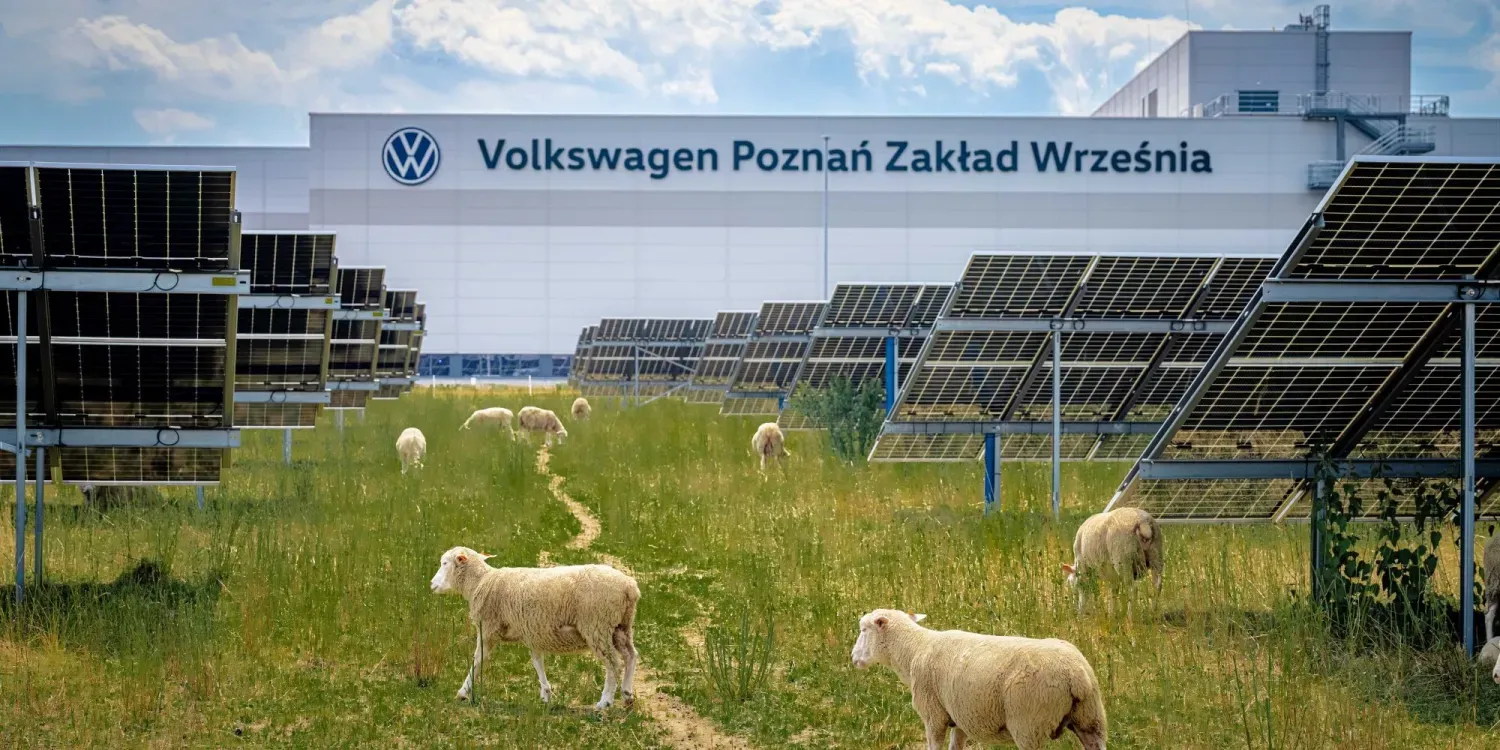
The project is being implemented in cooperation with the Poznań University of Life Sciences and studies how livestock farming and solar generation can coexist on the same land, writes Elektrek. For Kazakhstan, which is actively building solar facilities in steppe regions, this is a practical model for dual land use.
The Gist
- Company Quanta Energy has built a solar farm with 31,000+ panels and a capacity of 18.3 MW for the VW plant in Poznań. On sunny days, it fully covers the plant's needs, with an annual share of about 25% of the plant's total energy consumption.
- Instead of mechanical mowing, a flock of 100 sheep tends the area — under the supervision of experienced shepherds and with the participation of scientists.
- The Poznań University of Life Sciences is studying the impact of solar panels on animal welfare, biodiversity, soil condition, microclimate, and vegetation — one of the most extensive agrivoltaic research projects in Europe.
- According to the flock's owner, Justyna Nowak-Gajek, the sheep adapted quickly: they split into small groups and graze calmly in different parts of the farm — a sign that the animals feel safe.
- The project runs until autumn — after which scientists will summarize the initial results of the study.
Lawnmower vs. Sheep: The Score is Not in Favor of Machinery
Maintaining the territory of a solar farm is a real expense item: grass grows under the panels and needs to be mowed regularly. Mechanical mowing requires machinery, fuel, personnel, and creates noise and emissions. Sheep do the same thing for free — and simultaneously fertilize the soil.
But Volkswagen and Quanta Energy went further than simply replacing a lawnmower: the project deliberately includes scientific research.
"Agrivoltaics allows us to look at photovoltaic farms from a much broader perspective than just energy production," explains Dr. Joanna Skladanowska-Baryza from the Poznań University of Life Sciences.
According to her, scientists are studying whether the shade from the panels reduces heat stress in animals on hot days, how the microclimate changes under the panels, and how the soil reacts to the presence of the flock.
Agrivoltaics: When Land Works Twice
The concept of agrivoltaics — combining solar generation with agricultural land use — is gaining popularity worldwide. In China, the USA, and the UK, sheep flocks under solar panels have already become common practice.
The Polish VW project stands out for its scale and scientific component: it is not just a convenient solution for a specific plant, but an attempt to obtain reproducible data on exactly how livestock farming and solar generation can be combined.
Preliminary data from other countries is encouraging: many crops and animals tolerate heat better in the partial shade of panels — especially relevant in the context of growing climate anomalies.
Kazakhstan Context
Kazakhstan is actively building solar power plants in steppe regions — in the Zhambyl, Turkestan, Kyzylorda, and Karaganda regions. These are areas where sheep farming is traditionally developed. Combining solar generation with livestock grazing under the panels is a practically ready-made model for the domestic agricultural sector: the land simultaneously generates electricity and remains in agricultural use.
We have already written that a properly designed solar farm can restore biodiversity: a study in Minnesota showed a tripling of insect numbers under panels with wild grasses. The Polish VW project adds a new dimension to this picture: cattle and sheep as an element of the solar farm ecosystem — with measurable economic and environmental effects.
Author's Conclusion
Volkswagen put sheep under solar panels — and this is not a curiosity, but a systemic solution. Agrivoltaics turns a solar farm from a monofunctional facility into a multi-layered system: energy, pasture, research, biodiversity. For Kazakhstan, where solar power plants are being built in the middle of pasturelands, this model deserves not just attention, but a pilot experiment — preferably with the participation of domestic agricultural universities.



Comments ()