Vostoktsvetmet fined over mine whose closure court ruled illegal
Problems at the Yubileyno-Snegirikhinskoye field in East Kazakhstan have persisted for years, and a court previously ruled its liquidation act illegal.
A fine of 100 million tenge is not the beginning of the story, but one of its later episodes.
The essence in brief
- The specialized environmental prosecutor's office of the East Kazakhstan region identified prolonged inaction by Vostoktsvetmet LLP in eliminating the consequences of subsoil use at the Yubileyno-Snegirikhinskoye deposit in the Glubokovsky district — following the prosecutor's office's submission, the ecology department conducted an unscheduled inspection and fined the enterprise more than 100 million tenge under the article on exceeding technological emission standards.
- The enterprise was ordered to eliminate the consequences of subsoil use and ensure constant monitoring of the implementation of environmental protection measures.
- Polymetallic ore mining at the deposit was carried out from 2001 to 2016, and the act on completion of the facility's liquidation was signed in October 2019 — but the Astana court for administrative cases later declared this act unlawful, establishing that it had been signed with numerous violations of reclamation technology.
- After mining ceased, mine waters began to flow uncontrollably onto the surface and through a stream into the Malaya Karaguzhikha, Karaguzhikha and Uba rivers; laboratory studies revealed exceedances of permissible concentrations of heavy metals — zinc, cadmium, iron and manganese — by up to 83 thousand times.
How the mine was closed, but the problem was not
The Yubileyno-Snegirikhinskoye deposit was discovered back in the late 1950s, and its industrial development was launched in 2001 by KAZ Minerals — a company owned by businessmen Vladimir Kim and Oleg Novachuk. Copper ore was mined primarily, but the deposits also contained a high concentration of lead, zinc and other metals, including precious ones. Mining operations were halted in December 2016 after mineral resources were fully depleted, and the official act on completion of the facility's liquidation was signed by a commission of representatives of authorized state bodies in October 2019.
The problem is that this act, according to the prosecutor's office, was signed contrary to the actual state of affairs: during the mine's liquidation, technologies were violated, part of the reclamation work was not carried out, and the deposit's territory was not brought into proper condition. The environmental prosecutor of the East Kazakhstan region subsequently directly raised the question — on what grounds was the liquidation act even signed. The Astana court for administrative cases on April 17, 2024 declared this act unlawful; the company tried to challenge the decision on appeal.
The scale of pollution
The wording "exceeding technological emission standards," for which the enterprise was fined, in itself sounds dry and technical. But the figures behind it are of a different order: exceedances of heavy metal concentrations in water by up to 83 thousand times. Mine waters, left without control after mining stopped, came to the surface and through a chain of several water bodies — a stream, then the Malaya Karaguzhikha, Karaguzhikha and further the Uba river — carried pollution downstream. Specialists who surveyed the territory established the fact of pollution not only of water but also of soil and concluded that environmental damage had been caused.
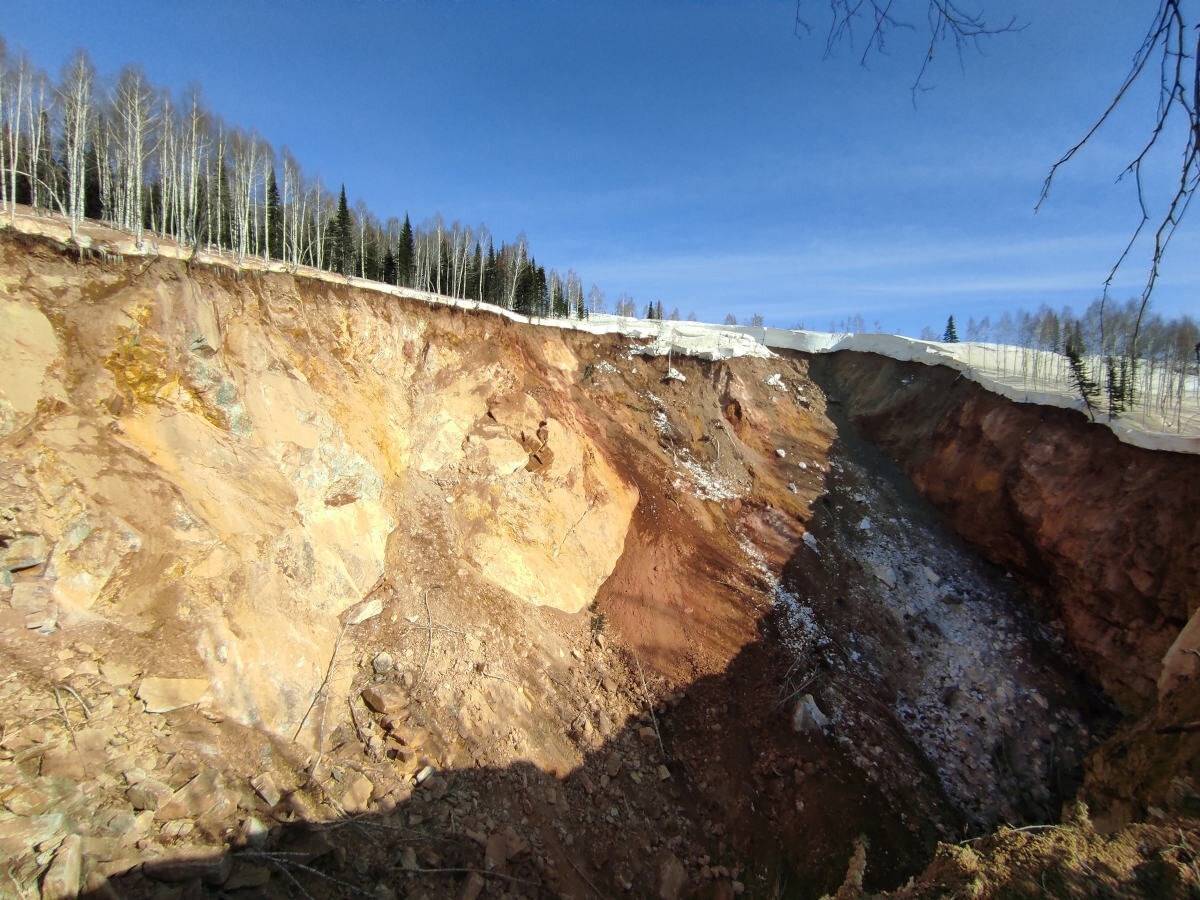
An additional, visually evident sign of problems at the site was a ground collapse that formed at the location of the liquidated deposit — the deposit is located on state forest fund lands, meaning the consequences affect not only water bodies but also the adjacent forest massif.
Part of a broader pattern of environmental control
The Vostoktsvetmet story is not an isolated case, but another point in the overall picture of intensified environmental control over major subsoil users, which we have been following all year. We have already written that the property of the Kashagan operator NCOC was placed under arrest, and the collection of the 2.3 trillion tenge environmental fine moved from paperwork to practice, and that earlier the Ministry of Justice warned the head of NCOC about administrative and criminal liability for non-payment of the same fine. Similar claims also affected Tengizchevroil — the operator of the country's largest oil field, accused of accumulating waste without a permit, and the quite small Emir Oil in the Mangystau region, where, at the request of a local deputy, a discharge of untreated effluent into the soil was found. The difference from Vostoktsvetmet is in scale and sector: from trillions of tenge in the oil and gas industry involving Chevron, ExxonMobil, Shell and other global majors to a couple of million tenge for a small regional subsoil user, whereas here the count is in hundreds of millions in domestic metallurgy. But the direction is the same: the state is increasingly demanding that subsoil users — regardless of company size, form of ownership and national origin of capital — actually eliminate, rather than merely declare the elimination of, the consequences of their activities.
Author's conclusion
The current fine of 100 million tenge is not the end point in this story, but another episode — and far from the first — in a multi-year proceeding: from the signing of the dubious liquidation act in 2019 to its judicial recognition as unlawful and now an administrative penalty. At the same time, the fine itself was issued under the article on exceeding emission standards, and not directly for falsification of the liquidation act — meaning various violations at the site are so far being punished piecemeal, in different proceedings, rather than within a single comprehensive investigation. The order to eliminate the consequences of subsoil use formally obliges the company to rectify the situation, but history shows: a similar obligation already existed in 2019, when the subsequently contested act on completion of liquidation was signed — therefore it is the actual implementation of the new requirements, and not the mere fact of their issuance, that will be the test of whether the matter is finally closed this time.

Comments ()