Wave energy moves closer to industrial use: 100-ton buoy receives first international safety certificate
Swedish firm CorPower Ocean has reached a key milestone for wave energy commercialization. Its CorPower C4 became the first wave energy device to receive an international safety certificate.
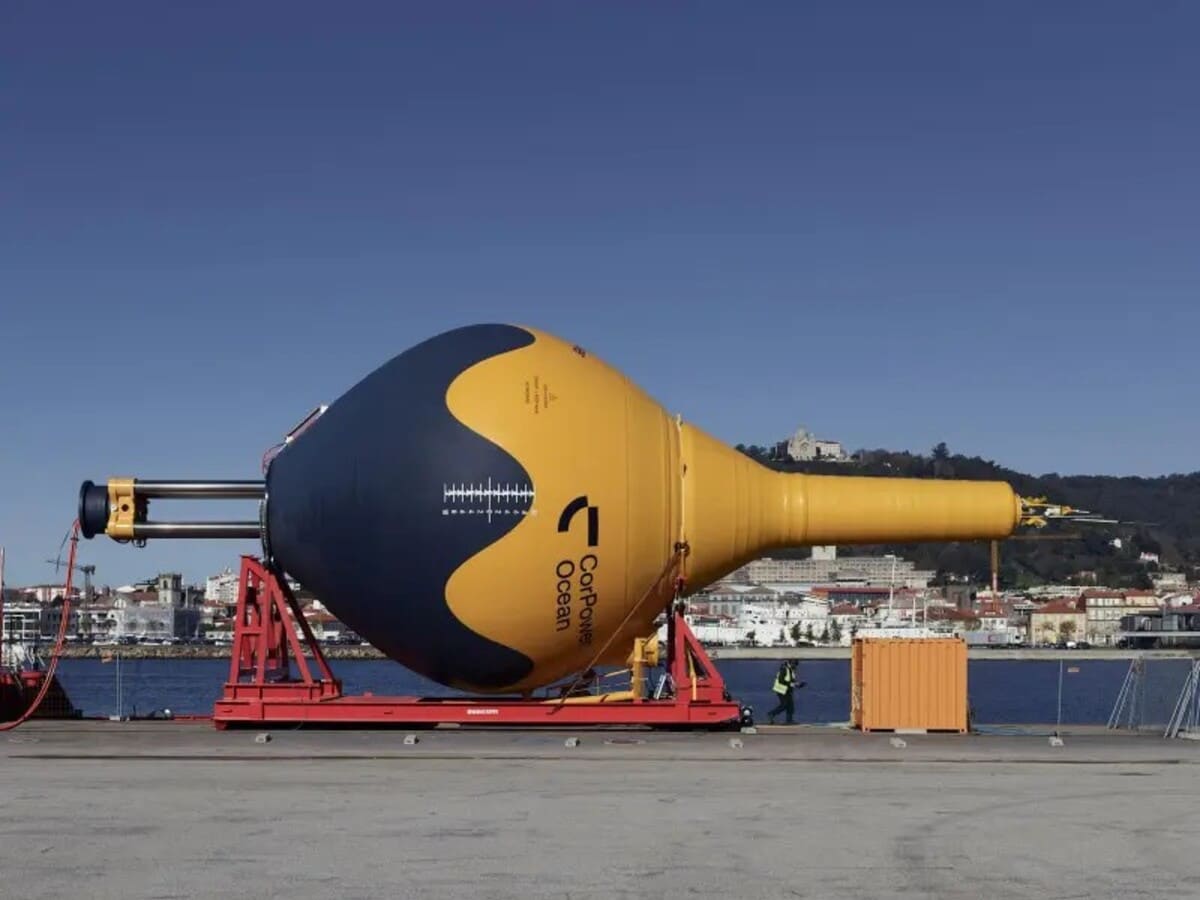
The development not only withstands storm waves up to 18.5 meters high but can also nearly triple electricity generation thanks to its own motion control system.
In a Nutshell
· The CorPower C4 wave energy converter became the first device of its kind to receive international safety certification.
· The buoy, weighing about 100 tons, can automatically change its operating mode depending on sea conditions.
· The patented WaveSpring system approximately triples the oscillation amplitude, increasing energy generation efficiency.
· The unit is designed to operate even during storms with waves up to 18.5 meters.
· The first commercial projects are planned for implementation in Portugal and Scotland in 2027–2029.
How the Marine Power Plant Works
The CorPower C4 is a teardrop-shaped buoy 9 meters wide, 18 meters high, and weighing about 100 tons.
The structure is anchored to the seabed by a tensioned tether. When a wave lifts the buoy, the tether pulls it back down with equal force, creating continuous reciprocating motion.
This energy is transferred to a system of flywheels and a gearbox, which distributes mechanical loads among several components, reducing equipment wear. The rotation then drives an electric generator, and the produced electricity is transmitted to shore via submarine cables.
Why the Device is Compared to a Human Heart
The main feature of the CorPower C4 is its proprietary WaveSpring technology.
Unlike conventional shock absorbers that dampen oscillations, WaveSpring amplifies them. The developers compare the system's operating principle to a heart valve that interacts synchronously with blood flow.
Thanks to this, even in relatively calm seas with wave heights of about one meter, the buoy can oscillate with an amplitude of up to three meters. This allows for an increase in the amount of energy extracted by approximately three times compared to conventional designs.
During a Storm, the Unit Becomes "Softer"
Another feature of the system is its automatic adaptation to weather conditions.
When a severe storm approaches, WaveSpring reduces the suspension stiffness, allowing the buoy to move almost freely with the water.
Instead of resisting the enormous waves, the structure begins to follow their motion, thereby withstanding waves up to 18.5 meters high without critical loads.
It is this capability that is considered one of the main factors enabling the device to pass international certification.
The Next Stage — Marine Power Plants
One buoy produces a relatively small amount of electricity, so the company is focusing on creating entire arrays of such units.
The CorPacks project involves combining dozens of buoys into a single marine power plant.
According to the developers' calculations, such complexes will be able to generate hundreds of megawatts of electricity — enough to power hundreds of thousands of homes.
The first commercial stations are planned for construction in Portugal and Scotland. If they confirm the stated characteristics after launch in 2027–2029, wave energy could transition from the category of experimental technologies to a full-fledged industrial sector.
What This Means for Kazakhstan
Although Kazakhstan does not have an ocean coastline, the development of such technologies shows how rapidly the range of low-carbon energy is expanding.
Previously, Hunn.kz reported on new approaches to solar energy development, including the technology for producing new panels from recycled old modules in Germany. On the commissioning of a hybrid energy complex in the Gobi Desert, which continues to generate energy for 8 hours after sunset. And also on the launch of the world's first floating wind turbine in the South China Sea.
These developments demonstrate a general trend in the global energy industry: engineers are already working not only on increasing generation volumes but also on improving the efficiency, reliability, and service life of installations, which is becoming a key condition for their mass adoption.
Author's Conclusion
Wave energy has been considered a promising but overly complex and expensive technology for decades. The CorPower C4 does not yet change the global energy balance, but obtaining international safety certification shows that the industry is gradually emerging from the experimental stage. If the first commercial stations confirm the stated performance indicators, the energy of sea waves will be able to carve out its own niche alongside solar, wind, and hydropower. And the main achievement will not be the buoy itself, but the proof that wave power plants can operate reliably in real marine conditions.
Comments ()