Who grows the most tea and coffee in the world — infographic
Two new Visual Capitalist infographics reveal where tea and coffee are grown worldwide—the crops behind billions of daily morning rituals.
For Kazakhstan, both rankings are not about domestic production, but about who the country buys from: neither tea nor coffee is grown on an industrial scale here, and import dependence is only growing.
The gist in brief
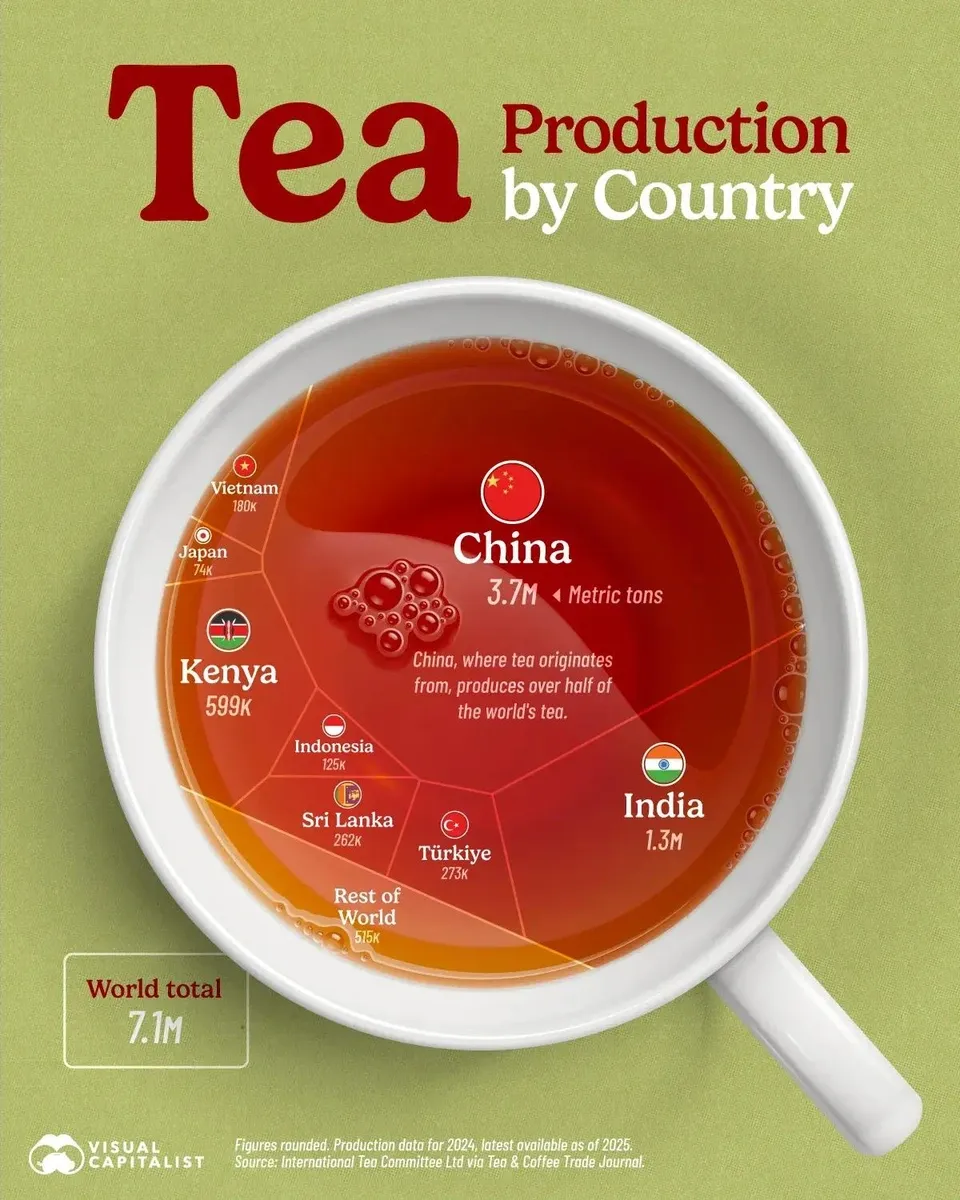
- According to Visual Capitalist based on the International Tea Committee, in 2024 China produced 3.74 million tonnes of tea — 53% of the global market, ahead of India (18%) and Kenya (8%); the eight leading countries together account for 93% of global production, totaling 7.1 million tonnes — almost double what it was 20 years ago.
- In the coffee ranking (data from the US Department of Agriculture for the 2025/2026 season), Brazil leads with 63 million standard 60-kilogram bags (35% of the market), followed by Vietnam (18%) and Colombia (7%); total global production reached 178.8 million bags.
- Kazakhstan does not grow tea or coffee on an industrial scale — the climate does not allow it; domestic "processing" is mainly packaging in Almaty, which accounts for less than a quarter of the domestic tea market.
- In January–July 2026, Kazakhstan imported 18.3 thousand tonnes of tea (74.1% of the market) and a record 3.2 thousand tonnes of coffee for the first half of the year — 38% more than a year earlier, while Kazakhs have been drinking less tea and more coffee.
Tea ranking: China's absolute dominance
China's leadership in the tea ranking can be called almost monopolistic — more than half of all global production is concentrated in a single country. India in second place and Kenya in third account for far more modest shares, while Kenya remains the world's largest tea exporter and the only non-Asian country in the top three. Rounding out the top 8 are Turkey, Sri Lanka, Vietnam, Indonesia, and Japan — notably, Vietnam and Indonesia are simultaneously among the top ten producers of both tea and coffee. About two-thirds of global production is black tea, and one-third is green tea.
Coffee ranking: the belt from Brazil to Uganda
The geography of coffee is strictly tied to the so-called coffee belt — a narrow band of tropical latitudes where arabica and robusta, the two main varieties, can be grown. Brazil accounts for more than a third of the global harvest, although local producers are increasingly considering switching from arabica to the more drought-resistant robusta. Vietnam is in second place with nearly half the volume, and Colombia rounds out the top three. The top 7 also includes Indonesia, Ethiopia, Uganda, and India — together, these seven countries control over 80% of the global market. By region, South America accounts for about 46% of production, Asia — 32%, and Africa — 13%.

Kazakhstan — not a producer, but an increasingly active buyer
For Kazakhstan, both beverages are exclusively imported goods: the country's climate is unsuitable for either tea plantations or coffee trees. In January–July 2026, the country produced 9.1 thousand tonnes of tea and coffee, but this is processing and packaging of imported raw materials, not cultivation — 92% of domestic tea "production" comes from Almaty alone. Imports are meanwhile growing multiple-fold: 18.3 thousand tonnes of tea cover 74.1% of the domestic market, with Kenya remaining the largest supplier — 27.2% of all imports, followed by India, Russia, Italy, and China. The picture for coffee is even more telling: imports in the first half of 2026 reached a record 3.2 thousand tonnes, 30% more expensive in monetary terms than a year earlier ($27.2 million), while Kazakhstan's own coffee exports amount to only 5% of import volumes. EnergyProm analysts also note a structural shift in consumer habits — Kazakhs are gradually drinking less tea and more coffee, although tea remains the more widely consumed beverage: on average, a resident of the country consumes about 100 grams of tea per month.
Author's conclusion
Global rankings of tea and coffee producers for Kazakhstan are, in essence, a map of dependence rather than a map of opportunities: none of the climate zones suitable for these crops passes through the country's territory. But that is precisely why Kazakhstan's import statistics are interesting in themselves — they show not production ambitions, but changing consumer tastes, where the growth in coffee purchases against the backdrop of declining tea consumption could become a notable trend in the coming years.



Comments ()