World Bank and ADB to finance modernization of Uzbekistan's substations
The World Bank approved a $100M loan to modernize 60 substations in Uzbekistan. With ADB's $200M credit and budget funds, the program totals $371M.
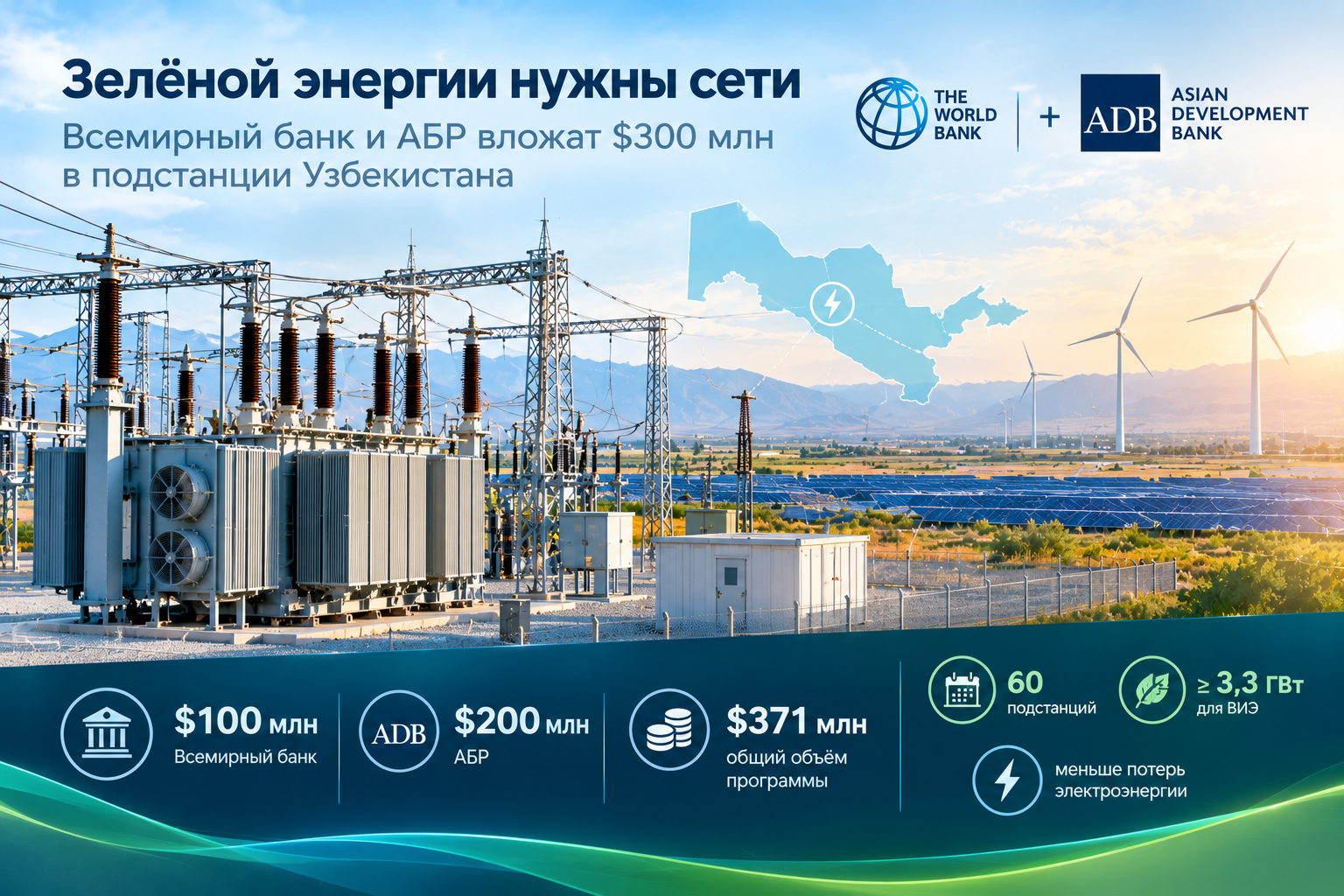
The program's goal is to prepare the grid to accommodate at least 3.3 GW of renewable energy capacity and reduce electricity losses, reports UzDaily.uz.
The essence in brief
- On October 27, 2026, the World Bank approved a $100 million loan to upgrade 60 key substations across the country.
- The total budget of the "Electricity Distribution System Modernization" program is $371 million: a World Bank loan, a $200 million ADB credit (approved on September 30), and $71 million from Uzbekistan's budget.
- By 2031, annual losses at the modernized substations are expected to decrease by 20,000 MWh, and the grid will be able to accommodate at least 3.3 GW of renewable energy capacity.
- Greenhouse gas emissions are expected to fall by nearly 23,000 tonnes of CO₂ equivalent per year. Over the five years after the facilities are commissioned, the program will create about 11,700 jobs.
- The implementing agency is JSC "National Electric Grids of Uzbekistan." In addition to substations, the project includes digitalization, cybersecurity, and strengthening of corporate governance.
The bottleneck of the energy transition
Uzbekistan intends to bring installed renewable energy capacity to 25 GW by 2030. But the energy generated at a solar or wind farm still needs to be delivered to consumers, and a significant portion of the distribution networks was built decades ago. As the World Bank notes, many substations operate under overload. This leads to electricity losses and outages that affect households, businesses, schools, and medical facilities.
Substations are the node where it is decided whether the grid will accept new generation. They are exactly what the program is modernizing.
One project — two banks
The World Bank and ADB work under the Full Mutual Reliance Framework. It envisions a coordinated approach to project preparation and implementation monitoring, which should reduce administrative costs and avoid duplication of procedures. In practice, this means one reporting scheme instead of two parallel ones.
Generation, storage, tariffs — and the grid
The loan fits into the picture we have already described: Uzbekistan is addressing energy transition challenges at several levels at once.
The first is attracting generation. Saudi Arabia's Acwa and South Korea's KOWEPO signed a memorandum to explore renewable energy and storage projects. Acwa has 19 projects in the country with a total capacity of more than 10 GW, and the company's investments could reach $15 billion. The grid must be able to accommodate such volumes.
The second is storage. Energy Minister Sherzod Khodjayev announced plans to deploy storage systems in all regions. Already today they cover more than 13% of the evening peak consumption. Storage systems smooth the gap between solar hours and evening demand, but they too connect to the same grid.
The third is demand management. A status of "exemplary consumer" is being introduced for businesses with a 15% prepayment instead of 100%. For large consumers, the daytime tariff is being reduced and the nighttime tariff increased, so load shifts to the hours when solar stations operate at maximum.
The fourth level is the grid itself, and that is exactly what the current loan addresses. Without it, the other three hit a ceiling of throughput capacity.
The Kazakh context
The implementing agency of the World Bank program, JSC "National Electric Grids of Uzbekistan," is also involved in a project that includes Kazakhstan. Together with Kazakhstan's KEGOC and Azerbaijan's Azerenerji, it established the Green Corridor Alliance on July 1, 2025 — a joint venture for the Trans-Caspian Green Energy Corridor. This route is intended to transmit electricity from Central Asia to Europe. The alliance recently signed a memorandum with Siemens Energy, but a feasibility study is not yet available: it is expected by May 2027.
The Uzbek grid company operates at two levels simultaneously: it is upgrading the domestic grid and participating in the construction of an export route. The Uzbek side has stated that for export it will build separate generating capacity so as not to burden its own power system. This means that grid throughput capacity is being taken into account on the export track as well.
For Kazakhstan, which participates in the project through KEGOC, the same questions remain open as for its neighbor: how much electricity can realistically be sent for export, where will the export green generation come from, and who will finance the cable across the bottom of the Caspian Sea. This also applies to the 1 GW wind farm with 600 MWh of storage being built in the Zhambyl region: it will only work to its full extent if the grids are ready to accept this capacity and redistribute it. The Uzbek experience adds another lesson: alongside export ambitions, it is necessary to finance one's own grid infrastructure, including with the participation of international banks, as in the current program.
Author's conclusion
The World Bank and ADB are financing not new stations but what makes stations useful — substations. For scale: the 3.3 GW that the grid will be able to accommodate after modernization amounts to about 13% of the stated 25 GW of total installed renewable energy capacity by 2030. This means the program is a first step, not a solution to the entire task. For the region, the conclusion is simple: the energy transition is measured not only by the capacity of new stations but also by the grid's ability to accept them.
Comments ()