World fuel production in tonnes — where does Kazakhstan fit into this picture
Fresh infographic from Visual Capitalist ranks countries by physical volume of mineral fuel extraction — coal, oil, gas, and uranium — in 2024.
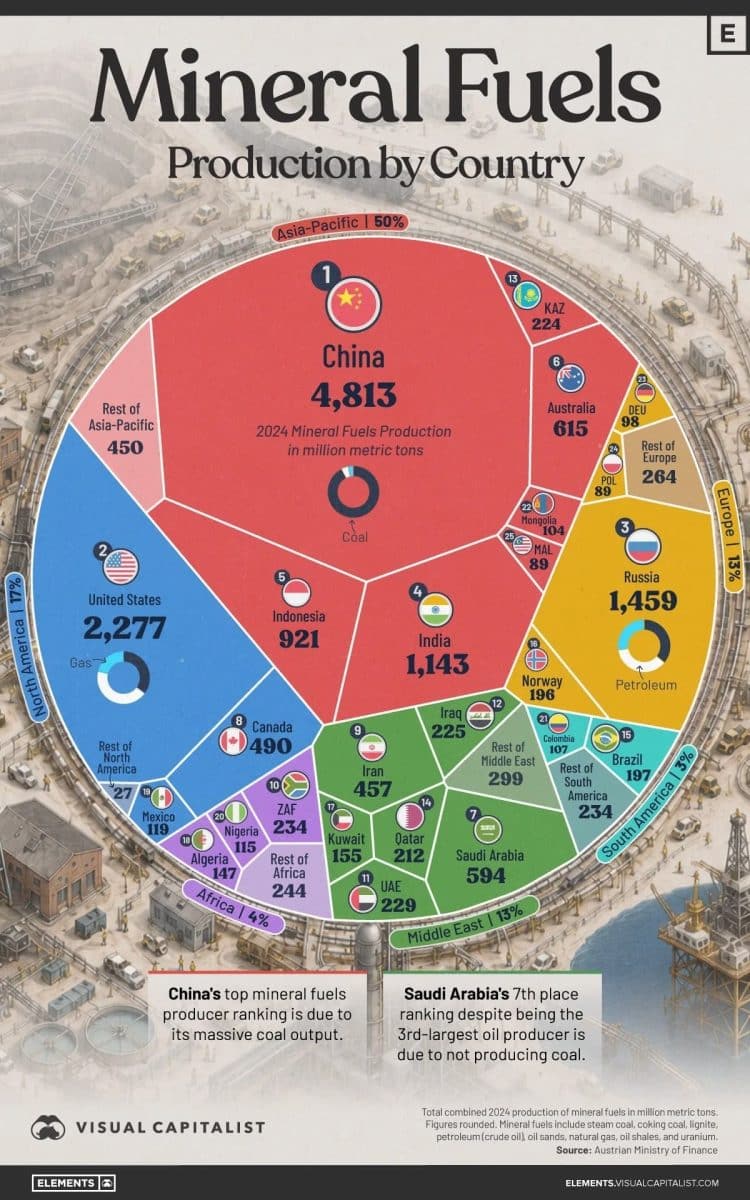
A methodology based on mass, rather than value or energy content, puts at the top not those with the most expensive resources, but those who extract the most coal. Kazakhstan does not make it into this ranking by tonnage, but remains the undisputed world leader in a much narrower and strategically significant category — uranium mining.
The gist
- In 2024, China became the world's largest producer of mineral fuels — 4.8 billion tonnes, or 28.6% of global extraction, mainly due to coal.
- The United States took second place (2.28 billion tonnes, 13.5%), Russia — third (1.46 billion tonnes, 8.7%), India — fourth (1.14 billion tonnes), Indonesia — fifth (921.4 million tonnes).
- The ranking measures precisely the physical mass of extraction, so coal — the "heaviest" fuel by volume — disproportionately determines countries' final positions.
- Kazakhstan is not in the top 5 of this weight-based ranking, but remains the world's No. 1 leader in uranium mining — 23,270 tonnes in 2024, more than a third of all global production.
How it was calculated and why coal wins
The data for the ranking was provided by the Austrian Federal Ministry of Finance, and the calculation itself covers thermal coal, coking coal, lignite, oil, oil shale, natural gas, and uranium. Since the measure is physical volume in tonnes, not value or energy output, the methodology systematically inflates the importance of coal: it is heavier by mass per unit of energy produced than oil or gas. That is why countries with large coal extraction end up at the top of the ranking, even if states with more developed oil and gas industries surpass them in value or in significance to global energy markets.
Top 5: different extraction structures among similar leaders
Formal proximity in the ranking does not mean economic similarity. In China, which took first place, almost all mineral fuel extraction is coal — about 4.8 billion tonnes out of 4.8 billion total. The United States, in second place, has a fundamentally different structure: its extraction base is oil and natural gas, where the country remains the world leader, not coal. Russia, in third place, is closer in structure to the American model — also mainly oil and gas. India and Indonesia, rounding out the top five, again rely on thermal coal. In total, the top five accounted for 63.1% of global mineral fuel extraction by mass, and China alone — nearly three tonnes out of every ten extracted worldwide.
Kazakhstan — not in this ranking, but a leader in its own
Kazakhstan's absence from the top of the weight-based ranking does not reflect its real significance in the global energy market — it merely shows the limitation of the methodology itself, which focuses on tonnage rather than the strategic value of a resource. According to the World Nuclear Association, Kazakhstan mined 23,270 tonnes of uranium in 2024 — more than a third of all global production, far ahead of second place. For comparison, the United States, the third most significant player in the global energy market, mined only 260 tonnes of uranium in the same 2024 — hundreds of times less than Kazakhstan's figure. The demand for this leadership is tangible right now: in early 2026, France tripled its purchases of Kazakh uranium and overtook China, taking first place among buyers — Europe is rapidly restructuring nuclear fuel supply chains to bypass Russia, and Kazakhstan, as the largest producer of natural uranium, finds itself in an advantageous position from both geopolitical sides. At the same time, Kazakhstan this spring also increased coal exports to several countries at once — the Netherlands, Malaysia, Poland — meaning the country remains a significant player in that very "heavy" mineral fuel market that determines the leadership of China, the United States, and Russia in this ranking, just on a substantially smaller physical scale.
Author's conclusion
The Visual Capitalist ranking clearly shows how strongly the calculation methodology determines the final picture: a country can be a world monopolist in one strategically critical resource and still not even make the top ten of the overall standings if counted in tonnes of coal. For Kazakhstan, this is more a reason for precise positioning than for disappointment — being the undisputed leader of the global uranium market, on which fuel for nuclear power plants around the world depends, including the one the country is building for itself, outweighs any place in a ranking built on the physical mass of fossil raw materials.
Comments ()