World map revealed each country's main export commodity.
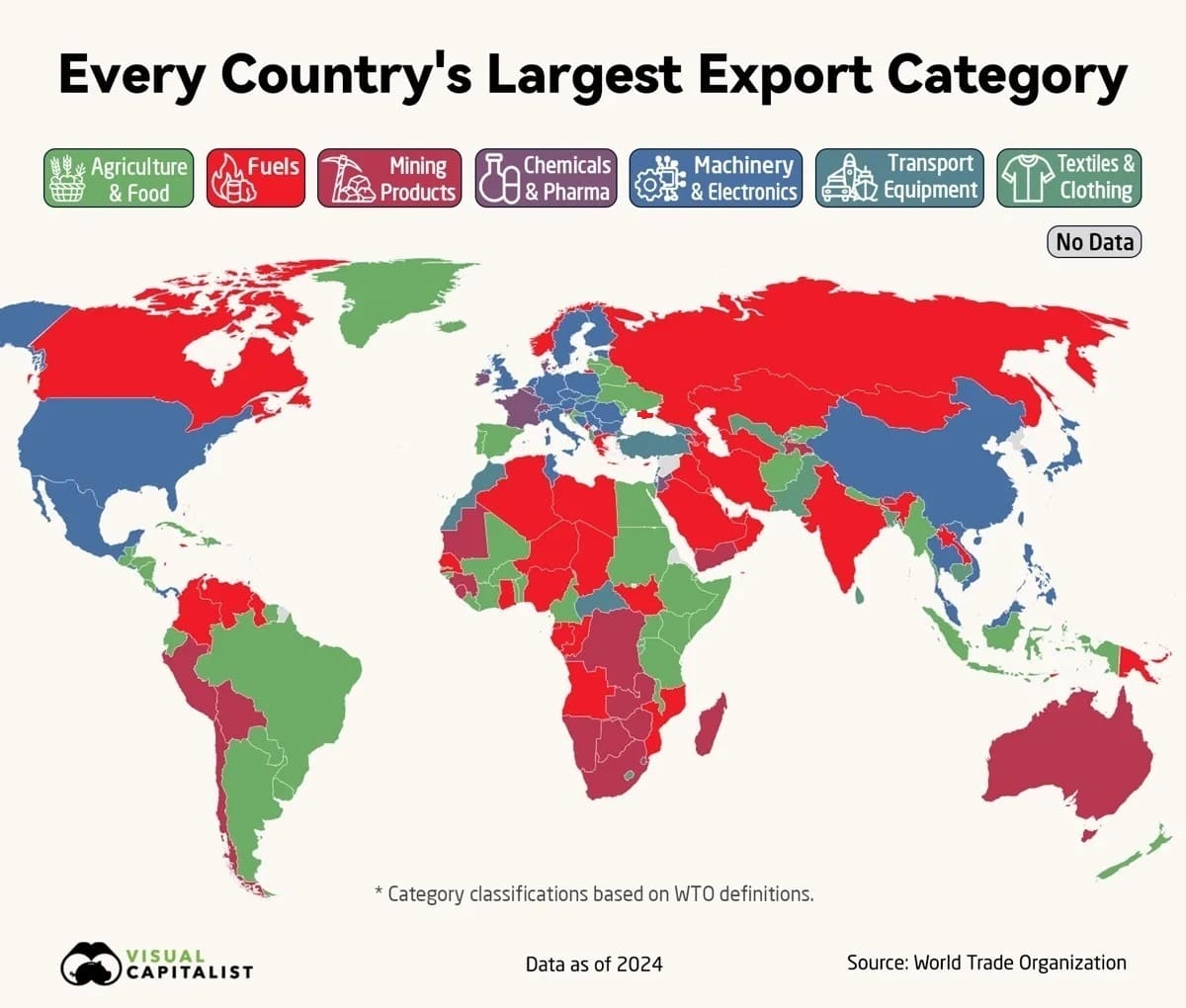
Visual Capitalist published a map showing the largest export category for every country worldwide.
For Kazakhstan, the result is only half expected — oil in first place will surprise no one, but the fact that uranium took second place is worth a closer look.
The gist in brief
- The Visual Capitalist map is based on World Trade Organization data for 2024 and shows the largest export category for each country in the world, excluding exports of services.
- China remains the world's largest exporter — in recent years its positive trade balance has exceeded $1 trillion, and machinery and equipment is the largest export category for four of the planet's largest economies at once: the United States, China, Germany, and Japan.
- For many countries, natural resources remain the foundation of exports: oil for Canada, Nigeria, and Saudi Arabia; gas for Algeria, Russia, and Qatar; copper for Chile and Peru; iron ore for Australia; cobalt and coltan for the Democratic Republic of the Congo.
- For Kazakhstan, oil remains the main export category — 50.5% of the country's total export revenue in 2025 — while radioactive chemical elements and isotopes (5.3%) — that is, uranium — took second place, ahead of even refined copper (5.2%).
Oil as the export destiny of dozens of countries
The logic of the map is simple: for countries that historically inherited rich deposits of a particular resource, that resource determines the structure of their entire merchandise exports. Canada, Nigeria, and Saudi Arabia have become major players in the global oil market; Algeria, Russia, and Qatar rely more heavily on natural gas; and Chile and Peru are traditional leaders in copper, whose lithium reserves have also gained strategic importance in recent years. A separate category of countries has bet on agriculture: for Argentina, Brazil, Egypt, Spain, and Ukraine, food and agricultural products remain the main export item.
Industrialization is changing the structure of exports
Over time, many resource-rich countries move beyond extractive industries — industrialization and technological development allow a gradual shift toward exporting products with higher added value. It is machinery and equipment — from automobiles, which Mexico and Poland actively trade, to high-tech products such as microchips — that have become the largest export category for the world's four largest economies. Some countries specialize entirely in individual links of production chains — for example, the Netherlands is home to ASML, the world's largest supplier of equipment for the semiconductor industry.
Kazakhstan's export structure — oil and uranium
For Kazakhstan, data on the export structure for 2025 sets priorities with absolute clarity: oil and petroleum products provide just over half of the country's total export revenue — 50.5%, or $39.88 billion from the sale of 76 million tonnes of oil to 29 countries. Italy remains the largest buyer ($15.2 billion), followed by the Netherlands, France, Romania, and Greece. But far more intriguing is the second position on the list — radioactive chemical elements and isotopes, in other words uranium, with a share of 5.3%, ahead of even refined copper. This is a direct reflection of what we have already written about: Kazakhstan remains the undisputed world leader in uranium mining, and demand for Kazakh uranium continues to grow — France tripled its purchases this year and took first place among buyers. At the same time, the country's non-commodity exports reached a record share of 37% in 2025 — meaning the dependence on oil alone is gradually, albeit slowly, declining.
Kazakhstan is not among the countries for which food is the main export category — Argentina, Brazil, Egypt, Spain, and Ukraine — since agricultural products still account for a much smaller share of revenue than oil and metals. But the dynamics in this area are noticeable: agricultural exports doubled in five years and exceeded $7 billion, and in the last marketing year alone the country sold 15.3 million tonnes of grain abroad — a record in 20 years, including sharply increased rice supplies to Afghanistan, which unexpectedly became the largest buyer of Kazakh rice. If such growth rates are maintained, food could well become far more prominent in Kazakhstan's export structure over time than it is now.
Author's conclusion
In the case of Kazakhstan, the Visual Capitalist map illustrates well the general thesis of the article: even a country with a dominant role of one resource in its exports — in this case oil — almost always has a second, less visible but strategically significant category that defines its place in global trade. For Kazakhstan, that second category is uranium, and judging by the growing global demand for it amid the revival of interest in nuclear energy, its share in Kazakhstan's export structure may grow faster than the oil share in the coming years.
Comments ()